

 |
News |
 |
Der Standard 25 April 2024
click for story
Nola 24 April 2024
click for story
New York Times 24 April 2024
click for story
The Art Newspaper 24 April 2024
click for story
New York Times 24 April 2024
click for story
The Commons 24 April 2024
click for story
Art Dependence 23 April 2023
click for story
New York Times 22 April 2024
click for story
Swissinfo 16 April 2024
click for story
The Canadian Jewish News 15 April 2024
click for story
Der Standard 13 April 2024
click for story
French Culture Ministry 12 April 2024
click for story
Science et Vie 12 April 2024
click for story
The Art Newspaper 8 April 2024
click for story
The Art Newspaper 1 April 2024
click for story
|
Websites and Resources |
|
Contains extensive information about research and restitution of cultural property including documentation, claims processes, laws, definitions, research resources, databases, bibliographies, restitutions, news and contacts.
click to visit
Records of 2,800 objects including paintings, sculptures, furniture and archaeological objects stolen by the Nazis in Belgium, both from private individuals and from public institutions.
click to visit
Biographies of individuals, companies and agencies, and the reconstruction of the trajectories of people and artworks.
click to visit
A digitised encyclopaedia of provenance research on individuals and institutions in Austria between 1930 and 1960
click to visit
The journal of the German and international art market digitised by the Heidelberg University Library, making it possible to search for artworks, collectors, auctions or museums from the Weimar Republic to the Nazi era.
click to visit
Files, documents and photographs from various sources that contributed to the identification, clarification of ownership and restitution of looted cultural property after 1945 in Germany.
click to visit
Biographical details of over 400,000 people from the 1939 German Minority Census, expanded with data from verifiable archival sources.
click to visit
Four German libraries - the Stiftung Neue Synagoge Berlin – Centrum Judaicum Library, the Freie Universität Berlin University Library, the Potsdam University Library, and the Berlin Central and Regional Library - have created a joint website with the provenance details of over 12,000 books which may be looted. For more information click here.
click to visit
Provides access to national laws currently in force (with translations), import/export certificates, contact details for national authorities and addresses of official national websites dedicated to the protection of the cultural heritage.
click to visit
Results of 'Museum Acquisitions from 1933' project showing 41 Dutch museums are in possession of at least 139 items with 'problematic' origins.
click to visit
Opened in June 2013, this government-run site provides details of museums' provenance research, advice on making enquiries, research and claims and links to relevant databases and archives in Switzerland and beyond.
click to visit
Digitised restitution case records of the Berlin Restitution Offices held in the Landesarchiv Berlin, consisting of the record group B Rep 025, Wiedergutmachungsämter von Berlin, containing more than 800,000 files.
click to visit
3,000 digitised auction catalogues including both German-speaking countries and the countries of occupied Europe - Austria, Belgium, Czech Republic Denmark, France, Germany, Italy, Netherlands, Poland and Switzerland - and including every genre of cultural object, from paintings to tapestries to silver and books. Provides the entire texts of auction catalogues. Searchable by auction house, artist, work of art, etc.
click to visit
More than 2,000 German language sales catalogues published between 1930 and 1945 including more than 230,000 individual auction sales records for paintings, sculptures, and drawings only. Searchable by artist name and nationality, lot title, buyer or seller’s name, city in which the sale occurred, type of subject matter and other fields. Provides only individual lot details, and links to Heidelberg for the full catalogue.
click to visit
Contains 4,263 paintings, sculptures, furniture, tapestries and other art objects, purchased or acquired from confiscated property, many available for restitution today.
click to visit
The Portal provides for the first time digital access to millions of cultural property records from the National Archives of the US, the UK, Germany, Belgium, Ukraine, France and other archival sources.
click to visit
Launched on 2 February 2011 by the Polish Ministry of Culture and National Heritage and including missing paintings from public and private collections by Raphael, Van Dyck, Rubens and others, reflecting the 70% of Poland's art lost to the Nazis.
click to visit
The Nazi records and photographs of the looting of more than 20,000 objects from Jews in France and Belgium. Click here for background details.
click to visit
c 43,500 paintings and c 13,000 persons and institutions associated with their acquisition or sale by the Munich art dealer Galerie Heinemann from 1890 to 1939. Click here for the full background.
click to visit
The history of the family, a copy of the July 2010 lawsuit filed in New York and photos of the artworks.
click to visit
The fate of more than 21,000 artworks condemned as “degenerate” by the Nazis and seized from German museums in 1937. Click here for background details.
click to visit
Index cards and photographs of the 170,000 works of art collected up by the Allies at the end of the war and inventoried from 1945 till 1951.
click to visit
A searchable, illustrated catalogue of the 4,731 works of art found by the Allies in the Linz Collection, with provenance details. Click here for detailed information.
click to visit
Hundreds of looted objects in Austrian public collections available for restitution.
click to visit
|
Conferences and Events |
|
|
Publications |
|
February 2024
Victoria S. Reed. An essay on the working relationship of German Jewish art dealers Paul Graupe and Arthur Goldschmidt which offers clues to the fate of other works of art placed in their custody which heirs of Holocaust victims may be seeking.
read more
January 2024
Florian Schmidt-Gabain. Swiss lawyer Florian Schmidt-Gabain summarises developments in 2023, focusing on restitution, the issues of the Bührle collection at the Kunsthaus Zurich, and the 'now outdated' distinction between looted art and flight art, showing how this change in understanding came about.
read more
January 2024
Eds Ulrike Saß and Christoph Zuschlag. Articles fall into four categories: Interviews, Research Articles (Peer Review), Research Reports and Case Studies.
read more
December 2023
Neill Lochery. Professor Neill Lochery's book explores how the "neutral" countries, Portugal, Spain, Sweden, Argentina and Brazil, profited from their trade with the Germans during the Second World War, and employed shady efforts to hold onto their profits in Nazi gold, looted art and other assets. He shows the flight of Nazi treasure through “neutral” countries after the war and the race to intercept the stolen assets before they disappeared, and before the will to punish Germany was replaced by the political considerations of the approaching Cold War.
read more
December 2023
Peter Wehrle (ed). An open access publication on provenance research and the art trade realised by the Munich auction house Ketterer Kunst with contributions by a range of specialist and academic authors. Chapters include provenance research in the auction houses and its sources, profiles of dealer and gallery archives, and concrete case studies on the collections of Olga Mengers, Isidor Bach, Fritz Benjamin, Paul Metz and Arthur Dahlheim. The book can be read online and/or downloaded here
read more
September 2023
RIHA Journal Special Issue 2023. Essays on the role of antiquities in the art world in the Nazi period, the aesthetics of National Socialism, antiquities collectors and dealers in Europe in the late 19th century and the first half of the 20th century, and the various ways in which antiquities changed hands during the precarious Nazi period. All essays are accessible as PDFs.
read more
July 2023
Olaf S. Ossmann. An exploration of post-war restitution, whether the Washington Principles have brought about 'fair and just solutions', and what is needed to provide justice for the dispossessed.
read more
April 2023
Angelina Giovani-Agha. On the key issues faced by art market professionals, independent researchers and curators, and with the aim of broadening the conversation on ‘How much due diligence qualifies as duly diligent’ and laying the groundwork for collecting, analysing, and interpreting previously unknown data in insightful and useful ways.
read more
March 2023
Johannes Nathan, Editor-in-Chief. A comprehensive guide to art galleries, auction houses, art fairs, and agents in Europe, Russia, and North America from multiple national and historical contexts.
read more
February 2023
Professor Amnon Lehavi. On the potential influence of global databases on rules and procedures for the restitution or return of cultural objects that have been stolen, looted, or illicitly exported across national borders.
read more
December 2022
Eds Ulrike Saß, Florian Schönfuß, Christoph Zuschlag . The first edition of the journal with essays in English and German on many aspects of provenance research including research reports, interviews, case studies and reviews. Available online on this site.
read more
November 2022
In a pathbreaking book, Geert Sels shows how paintings by Memling, Van der Weyden, Brueghel, Jordaens and Cranach left Belgium during the war and how many remain unreturned after the Nazis emptied homes, looted art, forced owners to sell and spent millions of Reichsmarks on the art market. Published in Dutch, French edition to be published on 24 January 2023.
read more
November 2022
Elisabeth Furtwängler, Mattes Lammert, eds. On the similarities and differences in the activities and acquisitions of German and French museums on the French art market during the Occupation and the location of those works today, through 14 essays from German and French authors each summarised on this site.
read more
October 2022
Dr Naida-Michal Brandl. In September 2019, under the direction of Dr. Ljerka Dulibic of the Strossmayer Gallery, the digitization of the KOMZA (Commission for the gathering and protection of cultural monuments and antiquities) archives held by the Ministry of Culture on the postwar fate of cultural objects nationalized under communism was completed. The Claims Conference/WJRO, together with Dr. Naida-Michal Brandl of the University of Zagreb, compiled an historical analysis of what these archival records are, whether from KOMZA under the communists or otherwise, and compiled a list of names of the original Jewish and other individual and organizational owners of the objects that were distributed after the war.
read more
October 2022
Professor Dr Christoph Zuschlag. A comprehensive introduction to the history and methods of provenance research, one of the most 'explosive' areas of art history.
read more
September 2022
Craig Hugh Smyth. Re-publication of Craig Hugh Smyth's 16 May 1995 English language lecture at the the Zentralinstitut für Kunstgeschichte, Munich, with an introduction by Iris Lauterbach.
read more
September 2022
Eds Ulrike Saß, Matthias Weller, Christoph Zuschlag. Chapter subjects range from provenance research on cultural objects from colonial contexts, Nazi looted property, cultural property confiscation in the Soviet Zone and the GDR to methodological issues. The legal essays deal with the civil law implications of the new German Cultural Property Protection Act, normative implications of the Washington Principles demand for just and fair solutions, and legal reactions to developments in the image sciences.
read more
May 2022
Michael Brenner. How Bavaria’s capital city, aided by politicians, judges, police, and ordinary residents, terrorised the Jewish population, becoming the testing ground for Nazism and the Final Solution, and why the city’s transformation into 'Hitler's city' is crucial for understanding the Nazi era and the tragedy of the Holocaust.
read more
May 2022
Karina Urbach. Alice Urbach had a cookery school in Vienna and in 1935 published a bestselling cookbook. In September 1938, after the Anschluss, Alice’s name was removed from her book. She was summoned to her publisher, Ernst Reinhardt Verlag, and told by her editor, Hermann Jungck, to hand over all her copyright and publishing rights. Her book was “Aryanised”, given a new “author” by the name of Rudolf Rösch. Alice’s preface to her cookbook, in which she had celebrated “the colourful mix of peoples that made up the former Austro-Hungarian monarchy”, was deleted, as were her recipes for Rothschild sponge and Rothschild omelette, plus any clues that the book was written by a woman. In 1948 Alice wrote to the publisher from her apartment in Manhattan, asking to have her rights back and her name restored. The publisher never did and kept on publishing the book. Alice died in 1983, aged 97. After the German publication of this book by her granddaughter Karina in 2020, Ernst Reinhardt Verlag reprinted the original 1935 edition of Alice’s cookbook, with her name on the jacket. Every German and Austrian library has been sent a copy.
read more
May 2022
Bénédicte Savoy. On the decades-long fight by African nations for the return of countless works of art stolen during the colonial era and placed in Western museums.
read more
April 2022
How the Nazis helped German tycoons make billions from the horrors of the Third Reich and World War II – and how the German movement toward facing the past somehow bypassed many of these revered tycoons and their dark histories.
read more
February 2022
Patricia Kennedy Grimsted. This Guide documents the current locations of remaining ERR files and related sources, details their contents, and provides links to the many files now online. The Guide also describes considerable documentation including the subsequent fate, postwar retrieval, and restitution of ERR loot.
read more
February 2022
Elisabeth Eggimann Gerber. A cultural history of the Swiss art trade focusing on Jewish art dealers and gallery owners, with a comprehensive portrait of the Aktuaryus Gallery in Zurich (1924-46) and the work of the Jewish art dealer and gallerist Toni Aktuaryus (1893-1946)
read more
January 2022
Arthur J. McLaughlin, Jr.. An analysis of the Third Reich’s efforts to confiscate, loot, censor and influence art that begins with a brief history of the looting of artworks in Western history. The artistic backgrounds of Adolf Hitler and Hermann Goering are examined, along with the Nazi art looting organisations, and Nazi endeavours to censor and manipulate the arts.
read more
December 2021
Gabriele Kohlbauer-Fritz and Tom Juncker . The Rothschilds in Austria played a significant role in the political and economic development of the country, founded important banking and industrial enterprises as well as charitable institutions. When the National Socialists came to power in 1938, the looting of the family's assets began, the restitution of which continues to this day. The book is the catalogue of the exhibition at the Jewish Museum Vienna which began on 12 December 2021 and runs until 5 June 2022.
read more
November 2021
New York attorney Raymond Dowd argues that the common law remedy of impressment of a constructive trust (trust ex malificio) is the proper approach in resolving Nazi looted art cases.
read more
October 2021
Evelyn Adunka. The autobiographies of 364 Jewish authors born between 1833 and 1963 who describe in the context of their lives the great Jewish hopes and disappointments in the age of emancipation and, in the 20th century, the signal events of the Shoah and the founding of the State of Israel.
read more
September 2021
Alexander Herman. Special discount of 20% off for newsletter readers till 31 January 2022. An overview by the Assistant Director of the Institute of Art and Law of the complex issues surrounding the restitution of cultural property and the difficult application of our contemporary conceptions of justice to instances from the past. The book asks whether we are entering a new 'restitution paradigm', one that could have an indelible impact on the cultural sector - and the rest of the world - for many years to come.
read more
September 2021
Edited by Bénédicte Savoy, Felicity Bodenstein, and Merten Lagatz. Who owns cultural assets? Who has narrative control? What could fair and just approaches to dislocations of cultural assets look like, independently of restitution?
read more
August 2021
Sophie Schönberger. Can late returns make up for past injustices? What must, what should, what can be returned? Sophie Schönberger, professor of public law, art and cultural law, shows the difficulties, but also the opportunities, of dealing with a past that is constructed from the present.
read more
July 2021
Meike Hoffmann and Andreas Hüneke.
read more
June 2021
Tabitha Oost explores critiques of Dutch restitution policy and concludes that institutional and substantive vulnerability is inevitable within a morally induced framework based on mere policy rules rather than legal rules.
read more
March 2021
Menachem Kaiser. The story of the author's quest to reclaim his family’s apartment building in Poland—and of the astonishing entanglement with Nazi treasure hunters that follows.
read more
January 2021
First published by the late Norman Palmer in 2000, the new edition has gathered contributors from over ten countries to show the important changes that have taken place around the world in the last 20 years.
read more
January 2021
Johannes Gramlich. On the 900 works of art from the collections of the Nazi leaders which entered the holdings of the Bavarian State Painting Collections in Munich in the 1950s and 1960s. Johannes Gramlich ask why and by whom some of these objects were returned to the families of the Nazi leaders or sold to third parties, a story described as one of great greed for profit, tactical silence and a sense of responsibility that grew only slowly and with much delay.
read more
January 2021
Theresa Sepp . In this 2020 doctoral thesis, Theresa Sepp explores the career of Ernst Buchner (1892-1962) twice general director of the Bayerische Staatsgemäldesammlungen in Munich, first during the Nazi era and then again after it. She looks at his successful strategy of justifying and reinterpreting his activities after the end of the war, revealing him as a case study for personal continuities in the post-war period as well as for the suppression of the past within the art world and beyond.
read more
December 2020
Eds Prof. Dr. Matthias Weller, Mag. rer. Publ., RA Dr. Nicolai B. Kemle, Prof. Dr. Thomas Dreier, Dr. Karolina Kuprecht, LL.M. Proceedings of the Thirteenth Heidelberg Art Law Conference in October 2019
read more
December 2020
Ed. Arthur Tompkins. Covering key aspects of provenance research for the international art market. It guides the reader from a basic introduction to research methods to questions of ethics and the challenges of specific case histories and contexts.
read more
|
Welcome to lootedart.com |
|
This site contains two fully searchable databases.
The Information Database contains information and documentation from forty nine countries, including laws and policies, reports and publications, archival records and resources, current cases and relevant websites.
The Object Database contains details of over 25,000 objects of all kinds – paintings, drawings, antiquities, Judaica, etc – looted, missing and/or identified from over fifteen countries. All images on the site are published under fair use conditions for the purpose of criticism and research.
Essential Website Links 2024: To see our list of key research sites on looted artworks and resources, click here.
For on all aspects of looted art, the art trade, archives and restitution, click here. For details of the most recent international resources, click here and also see below, Online Resources and Case News.
To subscribe to our looted art newsletter click here.
NEW
The grant will be offered to four recipients (£5,000 each), to fund forward-thinking academic, post-graduate research into subjects related to Nazi-era provenance research and restitution. In addition, and new in 2024, Christie’s will offer five grants of £1,000 each to undergraduates who are studying Nazi-era and restitution-related topics, and who may be considering a future career or study in this area, with a view to deepening their interest in the subject. The application process is open to students in art history or with an interdisciplinary interest in Nazi-era related provenance research. The deadline for submissions is 30 June 2024.
For further details and how to apply, please see here.
University College London (UCL), and the Victoria and Albert Museum (V&A) have announced the availability of a fully funded Collaborative Doctoral Studentship from October 2024. This interdisciplinary doctoral project aims to critically assess and visualise the complex networks behind the acquisition of the V&A’s Asia collection, comprising over 165,000 objects acquired 1852-2023. By employing digital humanities methods to the V&A’s registers and archives, the project seeks to address gaps in provenance data and contextualise the collection within the wider frameworks of imperialism, trade, and collecting practices. Closing date for applications 19 May 2024. For full details including how to apply, please see here.
The forum Collecting Central Europe (CCE) organises lectures, seminars, virtual guided tours, workshops and conferences with a particular emphasis on the history of collecting in Central and Eastern Europe which they define as the area once belonging to the Holy Roman Empire plus. Their intention is to break down barriers of research and communication between the European East and West. Events take place online in collaboration with universities, institutions and museums across Central and Eastern Europe and there is also an archive of events.
Their 2024 Committee is Andrea M. Gáldy (foundert of Collecting Central Europe), Markéta Ježková and Catherine Troiano. Founding members are Aistė Bimbirytė–Mackevičienė, Adriana Concin, Anne Harbers, Volker Heenes, Renate Leggatt-Hofer, Antoinette Maget, Mark A. Meadow, Elizabeth Pilliod, Jana Alexandra Raspotnig, Cecilia Riva, Franciszek Skibiński, Jeffrey Chipps Smith, Elke Valentin and Eliška Zlatohlávková.
Issued by the Federal Ministry of Culture and Media, the states and municipal associations, the paper states that they "agree that the procedure created with the establishment of the Advisory Commission in 2003 for the alternative resolution of disputed restitution issues needs to be modified in the light of the experience gained over the past 20 years in order to better fulfil the objectives of the Washington Principles". Key aspects involved include improving "the possibility of initiating proceedings vis-à-vis public cultural property preservation bodies, the inclusion of claimants in the proceedings and a binding evaluation framework for decision-making. Transparency and consistency should be guaranteed for all parties involved in the procedure at all times".
Key elements are:
1. Replacement of the Advisory Commission with an arbitration tribunal
2. New rules of procedure and a comprehensive, differentiated assessment framework.
3. Decisions to be legally binding and reviewable by a further body.
4. Unilateral access by a party
5. Provenance research to be strengthened with the possibility of commissioning additional expert reports during proceedings
6. Cultural institutions to clearly label cultural property confiscated as a result of Nazi persecution; and the often forgotten fates of art owners to be made visible to the public and appropriately honoured, this to apply particularly to confiscated works whose heirs cannot currently be identified.
7. Cultural institutions to consistently report restitutions and other just and fair solutions to the German Lost Art Foundation with the wish of restitution recipients for confidentiality to be fully honoured. Private individuals also be called upon to report fair and equitable solutions to the German Lost Art Foundation.
Both points 6 and 7 are to be implemented immediately. Points 1-5 will be implemented by the end of 2024 at the latest.
To read the paper, see here.
The U.S. State Department has released 'Best Practices for the Washington Conference Principles on Nazi-Confiscated Art' prepared by a network of Special Envoys and Representatives for Holocaust Issues from 14 countries in recognition of the 25th anniversary of the Washington Conference Principles. The Best Practices document defines 'art' as all kinds of cultural property; defines 'confiscated' as all methods of dispossession; states that all sales by a persecuted person between 1933-1945 can be considered equivalent to an involuntary transfer of property; and states that 'just and fair solutions' means just and fair solutions primarily for the victims of the the Nazis and their heirs, and that the primary just and fair solution is restitution.
There are 15 Best Practices set out in the document which can be viewed here and on the US State Department website here.
Also issued on 5 March 2024 was a Press Release by the US State Department here, Video Remarks by US Secretary of State Antony J. Blinken here, and Remarks by Stuart Eizenstat, Special Adviser on Holocaust Issues, Bureau of European and Eurasian Affairs, available here. The entire event is available as a transcript here and with a video here
The World Jewish Restitution Organization (WJRO) has issued a report on art restitution achievements and failures over the 25 years since the 1998 Washington Conference on Holocaust-Era Assets. The WJRO states that "while seven countries have made major progress in art and cultural property restitution, 24 countries from among the 47 surveyed have made minimal to no progress. Additionally, the report emphasizes the critical need to direct attention toward art and cultural property in private collections, signaling a vital area for future focus". To read the report, click here.
The FDHA regularly sent him envelopes with the applications to be processed. Since he had to send the original requests back to the office, he made detailed excerpts of these requests so that his decisions could be traced. He meticulously recorded the information about the applicants and suppliers of the pictures as well as the key data about the paintings to be imported. He creates very precise sketches based on the photos submitted by the applicants.
Some of the envelopes with Righini's excerpts have been preserved in the archives of the Righini-Fries Foundation. Unfortunately, the record is incomplete and only represents a part of the actual volume of requests. Nevertheless, this source is significant. Research in the Federal Archives has shown that art imports during the period in question are only fragmentarily documented. The original requests were destroyed after the then applicable retention period of 10 years. The documents in the possession of the Righini-Fries Foundation therefore represent a unique source. They shed light on the art trade in Switzerland in the 1930s and can provide valuable information for provenance research.
For further information: www.righini-fries.ch/die-forschung/provenienzforschung/ / katalog.kunstimporte.righini-fries.ch/intro/
The lootedart.com database now includes details of 230 seized artworks, mainly paintings and works on paper, as well as sculptures and a carpet, belonging to 13 German Jewish families, and which should be restituted. They were identified as a result of the work of the OFP Project Berlin-Brandenburg, funded by the German and federal state governments, which has been researching the 42,000 persecuted victim files of the Nazi Vermögensverwertungsstelle (Asset Realisation Office) established at the beginning of January 1942. The files record the systematic liquidation of victims' assets, and contain detailed information on the art objects that were seized and then disposed of by the Reich.
The collaboration with lootedart.com has enabled the publication of these seized artworks which include images of 34 of the artworks and the identification of the current location of six of the seized artworks. The OFP Project has compiled detailed files for each artwork which will be made available to the families so that they may pursue and recover the artworks.
Background: In 2019, the OFP Project Berlin-Brandenburg at the Brandenburgisches Landeshauptarchiv (Brandenburg Main State Archive) (BLHA), Germany,began systematically researching the 42,000 persecuted victim files (Rep. 36 A Oberfinanzpräsident Berlin-Brandenburg (OFP) (II)) of the Vermögensverwertungsstelle (Asset Realisation Office).
The Vermögensverwertungsstelle was established at the beginning of January 1942 as the mass deportation of Jews began, and was part of the Oberfinanzpräsident Berlin-Brandenburg (OFP) (Berlin-Brandenburg Finance Office) which was responsible for enabling the seizure of property of people persecuted by the Nazis as Jewish or hostile to the Reich. The victim files record the systematic liquidation of their assets, and, in some cases, contain detailed information on the art objects that were seized and then disposed of by the Reich.
As a result of the OFP Project’s work, many seized artworks have been identified, as well as the current locations for some of them. All the artworks are subject to restitution. The OFP Project has compiled digitised files and evidence of ownership and loss for each identified seizure, and will make those available to families whose art objects have been identified so that they may pursue claims.
In order to make this information widely available, the OFP Project sought a collaboration with lootedart.com, the Central Registry of Information for Looted Cultural Property 1933-1945. All the object information identified to date has now been published in the Central Registry database on this website. Further work by the OFP Project to identify more seized artworks and their current locations is ongoing and will be added to the lootedart.com database as it becomes available.
There are currently 175 individual entries of artworks seized from 13 different German Jewish families in the lootedart.com database. The 175 entries comprise a total of some 230 objects, and include mainly paintings and works on paper, as well as sculptures and a carpet. Images of 34 of the artworks have been identified by the OFP Project and are published. The current location of six of the looted artworks has also been found by the OFP Project.
The objects in the lootedart.com database are fully searchable by artist name, title of the artwork and by provenance. All identified artworks can be viewed by entering ‘OFP Project’ into the ‘Source’ field in the ‘Provenance’ section on the lootedart.com search page.
The names of the original owners have not been published as a matter of privacy. But any families seeking further information may contact either the OFP Project ofp.provenienz@blha.brandenburg.de or the Central Registry info@lootedart.com.
Anyone with further information on the current location of any of the artworks published in the Central Registry database should also contact either the OFP Project ofp.provenienz@blha.brandenburg.de or the Central Registry info@lootedart.com. All contact details are provided with each entry.
The OFP Project is funded by the German federal and state governments and will run until 2026. For full details of the Project please see here for the English language text and here for the German text.
On 24 January 2024, lootedart.com announced the publication in its database of 230 seized artworks, mainly paintings and works on paper, belonging to 13 German Jewish families, and identified as a result of the work of the OFP Project Berlin-Brandenburg (see below for further details). The OFP Project has now made available online digitised copies of the approx, 40,400 source files. These are from the Nazi Vermögensverwertungsstelle (Asset Realisation Office), established at the beginning of 1942, and which documented the systematic sale of the victims' assets. The files are in the Brandenburgisches Landeshauptarchiv (Brandenburg Main State Archive) in record group Rep. 36A Oberfinanzpräsident Berlin-Brandenburg (II).
The OFP Project hope the digitised files will 'promote a serious and critical examination of the Nazi era, an engagement with one's own family history and the creation of a democratic, pluralistic and diverse culture of remembrance'. The files will also provide evidence of loss due to persecution and therefore will be essential documentation in any claims made by the families. The OFP Project encourages any family, researcher or interested party to contact them with any questions at ofp.provenienz@blha.brandenburg.de
The Universiteit van Amsterdam is offering a new Master specialisation in provenance research and restitution within the Dual Master’s programme Heritage and Memory Studies. This unique and interdisciplinary programme is now open for registration through March 1st, 2024. For more information and eligibility requirements follow the link: https://ow.ly/4lls50QCzkB
Matthew Bogdanos, the Manhattan District Attorney, on Friday 22 February filed a turnover motion for the return of the Egon Schiele artwork 'Russian War Prisoner' from the Chicago Art Institute to "its lawful owner, the heirs of Fritz Grünbaum: Judge Timothy Reif, David Fraenkel, and Milos Vavra". Chicago is contesting an earlier court order to return the drawing.
In the motion, the DA wrote that "the documented inventorying, impounding, and eventual sale of Fritz Grünbaum’s stolen art collection is one of the most flagrant Nazi-era lootings of a Holocaust victim’s cultural property yet uncovered. The evidence demonstrates that Grünbaum’s art collection, particularly his 80-plus works by Egon Schiele, were systematically stolen from Grünbaum after he was imprisoned in the Dachau Concentration Camp for the crime of being Jewish and then sold for personal profit as part of a conspiracy involving at least the following two individuals. First, was Nazi-looted-art trafficker and launderer Eberhard Kornfeld, who operated out of his Bern, Switzerland, auction house. The evidence will show that not only was Kornfeld known to have dealt in Nazi-looted art throughout his career, most especially in the post-war years, but also it was through his machinations that Fritz Grünbaum’s Schieles were laundered for so long.. Second, was gallerist Otto Kallir, who operated out of his New York City gallery. The evidence will show that Kallir had known Grünbaum personally in Vienna between the two world wars and had coveted Grünbaum’s Schiele collection prior to Grünbaum’s 1938 arrest by the Nazis. As a result, after Grünbaum’s Schiele artworks, including Russian War Prisoner, were stolen by the Nazis and laundered by Kornfeld, many were brought to the United States by Kallir, and ultimately purchased from his New York City gallery by American museums or private collectors.
To read the 160 page application, please see here.
At the online conference 'Restitution of Nazi-Looted Art: The Next 25 Years' on 17 January 2024, marking the conclusion of a three-year joint project of the Bonn and Tel Aviv Universities, Ambassador James Bindenagel, former US Ambassador for Holocaust Issues (ret), gave a paper titled 'Just and Fair Solutions – From Principles to Law' .
Ambassador Bindenagel worked with Ambassador Stuart Eizenstat to formulate the 1998 Washington Principles on Nazi-Confiscated Art. His paper explores the two critical problems that he identifies as having emerged over the last 25 years. These are firstly the 'hoarding' by governments of information about provenance and the implications of this widespread lack of transparency in thwarting justice; and secondly the treatment of Holocaust-era confiscated property by governments as their own property and the necessity of this ceasing to happen. He calls for all governments adhering to the Washington Principles to mandate that any property in government or museum possession where Holocaust-related transfer or confiscation cannot be ruled out be deemed held in perpetual trust. He also calls for governments and museums, as custodians of this property, to publish each year a list of all works in their trust, all associated provenance information and details of steps taken to contact any rightful owner(s) identified.
To read the paper in full, please click here.
Edited by Ulrike Saß and Christoph Zuschlag, and published at https://doi.org/10.48640/tf.2023.1, articles fall into four categories: Interviews, Research Articles (Peer Review), Research Reports and Case Studies. For a complete list of the contents and links to all the articles, please see here.
For students interested in examining the socio-legal and economic ramifications for when property goes missing during war, genocide or man-made/natural disasters. After these events, there may be a misalignment of ownership and possession of art, objects (chattels) or even land. It may be contentious as to whether such property was sold, abandoned, stolen and so on. These are uncomfortable conversations at the national and international levels. There are international treaties to be considered, sometimes local laws, as well as many lessons to be learnt from the horrific experiences from the Shoah (Holocaust), Cambodia, Rwanda, Darfur, Bosnia and Herzegovina, as well as earthquakes, tsunamis and other impactful man-made/natural disaster events. For full details, see here.
A provenance researcher and historian at the Hamburg State and University Library, Anneke de Rudder has done exhaustive research on the lives of Jews in the Lower Saxony town of Lüneburg and elsewhere for many years. She has focused on researching objects looted by the Nazis, finding and contacting the rightful owners or their heirs. Many of these descendants have come to Germany, and she has introduced them to their ancestors’ hometowns and built connections between them and contemporary Germans. This includes, at the request of the Lüneburg Museum, leading efforts to find almost 60 heirs of a once-prominent Jewish citizen of Lüneburg, Marcus Heinemann, and helping organize a restitution ceremony attended by several dozen descendants. She is also developing a digital database of Lüneburg’s Jewish famlies, featuring names, dates, stories, and photographs. It will serve as a resource for descendants, local residents, and researchers worldwide. The Award will be presented in Berlin on 29 January 2024.
The Obermayer Awards, organized and administered by Widen the Circle, honor German individuals and groups that have illuminated the vital role Jews played in German society for hundreds of years before the Nazi era. The awards also honor those who use the lessons of history to fight against modern-day prejudice and racism (including antisemitism), and who foster the kind of understanding among different groups that prevents prejudice from taking root. For further details, please see here.
Issued at the end of December, the Newsletter includes articles on two recent Dutch Restitutions Committee cases leading to restitution of artworks to the heirs of Herman Hamburger and Jacob Lierens; news that an English version of the Origins Unknown website was launched in late September; and information that the RCE (Dutch Cultural Heritage Agency) is marking the 25th anniversary of its restitution policy with four roundtable discussions in the spring and a symposium in September 2024. To read the Newsletter, click here.
In the judgement handed down on Tuesday, the US Court of Appeals found that the Pissarro, Rue Saint-Honoré Après-midi, Effet de Pluie, in the Spanish government owned Thyssen-Bornemisza Collection in Madrid was legally the property of the Spanish government under Spanish law, although there was no doubt that it had been looted from Lilly Cassirer in Germany in 1939. The museum does not dispute the history. Lilly Cassirer, and then her family, had tried to recover it since the end of the war. To read the judgement, click here.
Two ivory reliefs dating to 1637 were taken from Germany to the USA in 1945. We are seeking to find out who they belonged to with the intention of enabling their return. They measure 5.5cm x 9.3cm, are each dated 1637, are in their original wooden frames measuring 10.3cm x 10.6cm and have the original red wax seal on the recto bearing the initials KBHZA (Königlich Bayerische Haupt Zoll Amt). If you have any information, please contact info@lootedart.com
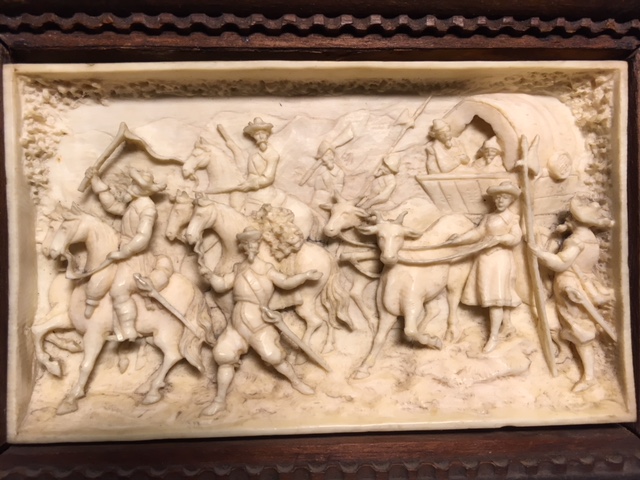
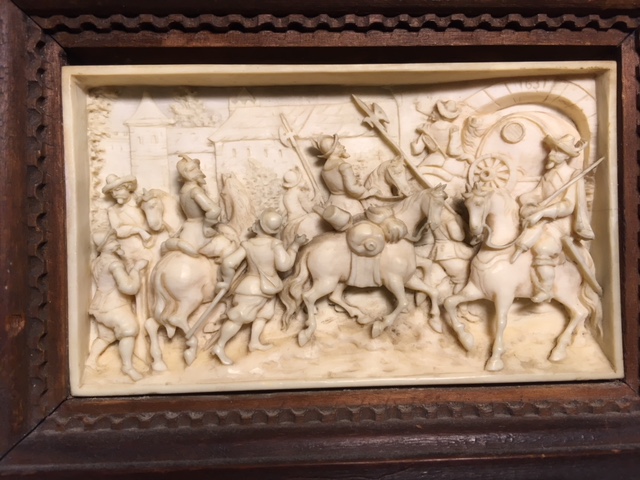
Issued under the current UK presidency of the Network at the end of December 2023, the newsletter includes news from France and the Netherlands, case decisions, research and studies from the UK (Bing, and research training in UK museums), Netherlands (Gosschalk and Drey), Austria (von Mendelssohn, Brill, Pollak, Reichmann, Rothschild, Teutonic Order and unknown owners of printed materials, research at the Museum of Military History, and new additions to the Lexicon of Austrian Provenance Research on persecutees (Rudolf Hirschenhauser, Helene Richter, Richard Neumann, Saul Juer, Alexander Roda Roda, Mary Wooster and Valentine Springer), museum employees (Anton Kraus, Berta Eichinger, Johann Eichinger, Friderike Klauner and Bruno Thomas) and five conservators (Sebastian Isepp, Eduard Kneisel, Elisabeth Krippel, Ingeborg Spann and JohannesWilde)). It also includes the Memorandum issued by the German Advisory Commission on 4 September 2023. To read the newsletter, click here.
The 12-month position at the Beratende Kommission NS-Raubgut involves:
- Supporting the Commission in processing cases
- Assessment and scientific processing of the parties' submitted pleadings
- General and case-specific research, identification of sources and literature and archive research
- Writing status reports on the Commission's cases in coordination with the rapporteur
- Supporting the Commission in developing draft recommendations
- Preparing and documenting the work of the Commission and general discourses on restitution practice- preparation and follow-up of Commission meetings.
Applications by 5 January 2024. The full job specification and requirements are available here.
On 22 November 2023, the Swiss Federal Council adopted a decree establishing an Independent Commission for Historically Burdened Cultural Heritage, implementing a corresponding mandate from Parliament. The Commission will deal with cases of both Nazi-looted art and colonial heritage. The Council said that during the National Socialist era, numerous Jewish-owned cultural assets were directly or indirectly expropriated. Such looted art also found its way to Switzerland, among other places. Restitution and compensation claims have been asserted since the end of the Second World War. This regularly leads to legal uncertainties and disputes. Dealing with such historically burdened cultural heritage is an important goal of the Confederation's cultural policy. The Federal Council supports the transparent processing of burdened testimonies of the past and the implementation of fair and equitable solutions. With the independent expert commission, the Federal Council is setting up a body that can provide advice in controversial cases and make non-binding recommendations in individual cases. To read the Decree establishing the Commission, see the PDF here.
The Diplomatic Archives now offer fully searchable access to the inventories and digitized archives of the Commission de Récupération Artistique (Commission for Art Recovery) (CRA) section in the Ministry of Europe and Foreign Affairs files. More than 4,000 archival files, including some 2,700 detailed digital directories and more than 2 million archival pages, are now available for viewing, downloading, printing etc. through the search engine or navigation in the classification framework. They include:
- Les dossiers de réclamations des familles auprès de la Commission de Récupération Artistique (CRA) (Family claims files with the CRA)
- Les inventaires de l'Einsatzstab Reichsleiter Rosenberg (ERR) (1940-1959)(Inventories of the Einsatzstab Reichsleiter Rosenberg (ERR) (1940-1959)
- Les albums photographiques issus des dossiers de réclamation(Photographic albums from claims files)
New resources will be continuously posted online as the classification and digitization work progresses.
To access the digitised archives, visit https://archivesdiplomatiques.diplomatie.gouv.fr/ark:/14366/xdm9rgwv5nt1
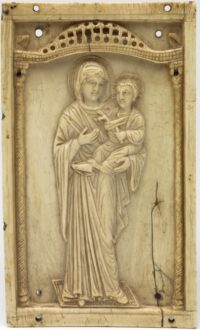
Hodegetria or Virgin and Child
The Dutch Restitutions Committee has issued a binding opinion in the case of a claim by the heirs of the A. S. Drey gallery in Munich for a Byzantine ivory relief entitled Hodegetria or Virgin and Child (maker unknown), which is currently held by Rotterdam City Council and is in the collection of Museum Boijmans Van Beuningen. The Committee stated that research by the Expert Centre Restitution (ECR) had shown that this artwork came from the collection of the gallery in Munich, which until 1936 was in the hands of the German-Jewish Drey family and that it had become sufficiently plausible that possession of the work was lost involuntarily due to circumstances directly connected with the Nazi regime. To read the decision of the Committee in which the history and assessment is set out in full, please see here.
The online journal transfer, an academic publication platform in the area of provenance research and the history of collection as well as adjacent fields of investigation, like art market studies, reception history, cultural sociology, or legal history, has issued a call for papers for its next edition. Authors are invited to submit papers on the following topics of interest: Translocation of art and cultural assets; Art and cultural property law; Culture of remembrance, Cultural identity, Collective memory; Collections, History of collection; Art trade, Art market studies; Art policy; Sociology of art, Cultural sociology; Restitution, Return, Repatriation; Provenance research on individual objects or object groups; Archival holdings, Primary sources. For full details and to submit, visit here.
The Wildenstein Plattner Institute has announced the release of the records of Michel and Irma van Gelder, Dutch collectors and dealers based in Uccle, Belgium, who assembled an important collection of Old Master paintings. The archives consist of business and personal art collection records including inventories, correspondence, invoices, and photographs. They provide insights into Irma van Gelder’s business practices and her wartime correspondence with officials of the Third Reich about works of art. The materials also illuminate aspects of the Old Master paintings market during the first half of the twentieth century. To review the records, please click here.
The fifth edition of the newsletter of the Cultural Heritage Agency of the Netherlands (RCE) on its activities regarding cultural objects that were looted, confiscated or sold under duress before or during the Second World War has been published. It includes information about research networks, updated websites and new resources including a provenance blog and news of publications. An important new resource are the 15,000 post-war claim declaration forms - Interne Aangifteformulieren - now all online and fully searchable.To read the newsletter, click here.
On 24 October, the European Parliament's Committee on Legal Affairs (JURI) will hear a presentation of the study 'Cross-border claims to looted art' written by Dr Evelien Campfens, published this month by the European Parliament. The study was commissioned by the European Parliament’s Policy Department for Citizens’ Rights and Constitutional Affairs at the request of the JURI Committee
The study addresses cross-border restitution claims to looted art, considering Nazi-looted art and colonial takings, but also more recent cultural losses resulting from illicit trafficking. It highlights blind spots in the legal and policy frameworks and formulates recommendations on how these could be bridged.
To read the study, click here. To watch the proceedings, please follow this link https://www.europarl.europa.eu/committees/de/juri/home/highlights
The Netherlands Institute for Art History (RKD) in The Hague is establishing an open access database of marks found on art objects, Marks on Art. A trustworthy and easily accessible database has been a longstanding wish in the field of art history and conservation studies. The current project phase focuses specifically on the digitisation, identification and digital publication of maker’s marks and guild hall marks on the reverse of 16th- and 17th-century Dutch and Flemish panel and copper paintings. At an earlier date, the RKD started documenting marks on medieval sculpture.The RKD calls on researchers, conservators and curators to send in photos of paintings with maker’s marks and/or guild hall marks. For full details of the call and the project, please click here.
The art business is a closed market worth billions and it is often impossible to look behind this glittering façade. Yet fake paintings or unclear ownership of works of art are part of everyday life. Germany's NPR Deutschlandfunk has produced a new 360 minutes storytelling podcast about the dark sides of the art world. All episodes can be heard here.
In the case of Philipp et al., v. Stiftung Preussischer Kulturbesitz the U.S. Court of Appeals upheld a previous decision denying the plaintiffs the right to have their claim judged on merit in a U.S. court. To read the judgement of the court, see here.
In its judgement, issued on 21 July 2023, Germany's highest civil court, the Bundesgerichtshof, ruled that the announcement of missing cultural property on the Lost Art data base’s web page, if based upon true facts, does not represent an impairment of ownership and that, therefore, such announcement does not constitute a claim of the present owner against the initiator of the announcement to cause the announcement’s deletion. To read the court's full press release about its ruling, see here.
The professorship, advertised by the Faculty of Philosophy of the University of Bonn in the Institute of Art History, is to be filled at the earliest possible date and has an application deadline of 17 September 2023. To see the job description and for application details, please see Bonn's document here.
David Lewis and Anne Webber, the co-founders and co-chairs of the Commission for Looted Art in Europe, have each been awarded a CBE in King Charles's first Birthday Honours List for 'services to the Return of Looted Art'. In a short statement, they said how much they appreciated the great honour and recognition of their work, and in particular the acknowledgement of the importance of restitution.
The CBE - Commander of the Order of the British Empire - is one of the United Kingdom's highest honours and is awarded to individuals with a prominent role who have made a distinguished and innovative contribution.
Professor Adam Ganz, media writer and great-grand-son of Felix Ganz (1869-1944) won a theatre prize to present a new form to remember Felix and his second wife Erna at the Berliner Ensemble theatre. The audience can immerse themselves in the story of Felix and Erna with the help of projected holographic effects and high-resolution 3D scans. Through technology, real places, journeys and memories appear on stage as if by magic. This collaborative project gives Felix and Erna image and voice as the artists of the Komische Oper Berlin and the Berliner Ensemble give new life to their story. A co-production of Komische Oper Berlin and the Berliner Ensemble in cooperation with ScanLAB Projects, funded by the Federal Government Commissioner for Culture and the Media. For full details and to book tickets, visit https://www.berliner-ensemble.de/en/production/felixs-room
Professor A.I.M. (Toon) van Mierlo has been appointed as the new Chair as from 15 August and Professor C.J.H. (Corjo) Jansen as a new committee member from 1 September.
Professor van Mierlo works part-time as a lawyer at Habraken Rutten. He is also a part-time professor at the University of Groningen and the Erasmus University Rotterdam. His other positions include chairman of the Healthcare Insurance Act Disputes Committee and member of the KNVB Arbitration Committee. Professor Jansen is professor of Legal History and Civil Law at Radboud University Nijmegen. He is the author of 'The Supreme Court and World War II. Law and the practice of law in the years 1930-1950' . He is also chairman of the board of the Grotius Academy and of the Research Centre for Business & Law.
The French National Assembly has unanimously passed the restitution bill "relative à la restitution des biens culturels ayant fait l'objet de spoliations dans le contexte des persécutions antisémites perpétrées entre 1933 et 1945". The Senate had already adopted the text on May 23. The text provides for an exception to the principle of inalienability, enabling a public entity owning property spoliated during the period between January 30, 1933 and May 8, 1945 in the context of anti-Semitic persecution, regardless of where the spoliation took place, to deaccession the artwork with a view to its restitution, after receiving the opinion of the Commission for the Compensation of Victims of Spoliation (CIVS). The decision to deaccession the item and return it will be taken, after the CIVS has given its opinion, by the Prime Minister (national collections) or by the local authority that owns the item (local authority collections: towns, départements, regions).
The final stage inthe legislative procedure is a meeting of a joint committee (CMP) of senators and deputies, and the final vote, which should be completed before the end of July.
Details of the text voted on can be found on the French National Assembly website: https://www.assemblee-nationale.fr/dyn/16/dossiers/DLR5L16N47616
In 2020 Germany's Lost Art Foundation opened an official ‘Help Desk’ for those seeking to reclaim Nazi-looted art. The office in Berlin, led by art historian Dr Susanne Meyer-Abich, aims to guide people around the bureaucratic hurdles for claiming back their cultural assets and to assist them in research and restitution. For further information and to contact the Help Desk, visit https://www.kulturgutverluste.de/Webs/EN/HelpDesk/Index.html
Since 2022, the Netherlands also has a new central information and contact point for claimants, part of the Cultural Heritage Agency (RCE). It was set up following the recommendation of the 2020 'Striving for Justice' report on Dutch restitution policy in order to help with 'questions, advice and information about restitution' in the Netherlands. It aims to facilitate submission of requests for restitution, and researchers can request provenance information and be referred to relevant archives and organizations. For further information, visit https://english.cultureelerfgoed.nl/topics/restitution-policy. To contact the Dutch Help Desk, email restitutie@cultureelerfgoed.nl.
These seminars, organised since 2018, and which, since 2022, have been a collaboration between INHA (Institut national d'histoire de l'art) and the French government's Mission de recherche et de restitution des biens culturels spoliés entre 1933 et 1945, focus on the spoliation of cultural property, the provenance of works of art, and the consequences of the loss and disappearance of these properties.
Recent subjects have included 'Patrimoine spolié pendant la période du nazisme (1933-1945) - Conséquences, mémoires et traces de la spoliation', 'Le procès Paul Rosenberg contre Emil Bührle, Suisse 1946-1951', 'Destinée d’un film spolié : Europa de Franciszka et Stefan Themerson', 'Artistes dépossédés, des ateliers pillés pendant l’Occupation', 'Le marché de l’art entre France et Allemagne' and 'Après la recherche – L’action de la Commission pour l’indemnisation des victimes de spoliations'.
All seminars are available to view on the YouTube INHA channel at https://www.youtube.com/playlist?list=PLsl8NWzVv6T1Vs_eafbgQS3UzDcF7HlOQ
An Inter-Ministerial Team for Regulating Holocaust-Era Provenance Research in Israel which has been working for two years to develop comprehensive proposals on research and restitution for both public and private collections has now submitted a legislative plan. It is available here in full in Hebrew and here as a summary in English. The Team's website is here.
The team involved the Ministry of Culture and Sport, the Ministry for Social Equality, the Ministry of Heritage, the Administrator General, and the Counselling and Legislation Department in the Ministry of Justice.
At the basis of the recommendations is "the aspiration to conduct provenance research i.e., to identify the owners of the works and cultural assets appropriated during the Nazi era, to locate their heirs and current rightful owners, and to formulate relevant just and fair solutions", which so far have not been available nationally in Israel.
The key recommendations are:
1. That 'Recognized Museums' (by the Ministry of Culture and Sport) be obliged to conduct provenance research on 'plastic artworks' - paintings, drawings, graphic works, sculpture - supported with funds from the Ministry of Culture. Failure to conduct research may lead to a reduction of financial support for the museum. The researchers must have proven experience and specially designated training on Holocaust-era spoliation.
2. That the Administrator General in the Ministry of Justice be authorised to conduct research to locate the rightful owners of looted artworks, legally verify their inheritance rights and reinstate their rights to the looted artwork.
3. That an Appeals Committee of a former judge, qualified lawyer and art expert be established by the Minister of Justice with jurisdiction over decisions of the Adminstrator General, disclosure obligations, the issuing of inheritance orders, etc.
4. That the individual museum finalise the settlement with the rightful owners or heirs either through restitution or other just and fair solutions agreed with the heirs.
5. That a dedicated website publish research, the location of rightful owners, the determination of rights, and the outcomes.
6. That where heirs cannot be traced, the work remain where it is and its history be commemorated.
7. That good faith acquisitions and statute of limitations be no defence against claims.
Eyal Dolev, an independent provenance researcher in Israel and moderator of the joint academic course "Nazi looted Art" (co-organized by Bonn University and Tel-Aviv University) has written an article commenting on the Israeli government proposals set out above.
He notes that the report prioritizes research of artworks once held by US collecting points. Also that until now, no governmental budget was allocated for provenance research but this research might be financed by the Israeli government in the future. Legislation to enable restitution is necessary in order to overcome the current protection provided by the Israeli law to bona fide purchasers. While some claims have been agreed in Israel, others have been rejected and the report 'genuinely suggests that a new mechanism will be deployed in settling these claims'. As for the future of the draft legislation, Dolev says that it is still unclear whether Yariv Levin, the Israeli Justice Minister who is currently extremely busy with promoting his controversial "legal reform," will find enough time to regulate the artworks issue in due course.
Eyal Dolev's article is available to read here.
The aim of ProvEnhance is to lay a global scientific and methodological frame for provenance research in Belgium for artworks acquired around WWII. As a real case-study, it will investigate and enrich the provenance data of artworks entered in the collections of the Royal Museums of Fine Arts of Belgium (RMFAB) from 1933 onwards, concentrating on the pre-war and post-war periods.
The project has three jobs available: Data scientist / Data manager / Database programmer (part-time) (m/w/x); Researcher – PhD Student (m/w/x) (WP3) and Researcher – PhD Student (m/w/x) (WP4). Application deadline 30 June 2023. For full details, click here.
The bill, presented by Culture Minister Rima Abdul Malak, is designed to facilitate the restitution of previously inalienable cultural property in French public collections and marks a historic step in the long road to reparation that began in 1995 with President Jacques Chirac's speech at the Vélodrome d'Hiver, recognising the responsibility of the French state in the deportation of French Jews during the Second World War. Decisions on restitution will be made by the Commission pour l’indemnisation des victimes de spoliations (CIVS) after an assessment of the circumstances of loss. Till now, an individual law has had to be passed to enable restitution in each successful claim. To read the press release issued by the Ministry of Culture, see here.
For students interested in examining the socio-legal and economic ramifications for when property goes missing during war, genocide or man-made/natural disasters. It may be contentious as to whether such property was sold, abandoned, stolen and so on. There are international treaties to be considered, sometimes local laws, as well as many lessons to be learnt from the horrific experiences from the Shoah (Holocaust), Cambodia, Rwanda, Darfur, Bosnia and Herzegovina, as well as earthquakes, tsunamis and other impactful man-made/natural disaster events. For further details, please see here.
Always available for research at Gimpel Fils in London, Galerie René Gimpel’s archives have now been digitised as a freely accessible online database of more than 10,000 documents from the professional and personal archives of the French collector and art dealer René Gimpel. Letters from artists and clients, photos of artworks, stock lists, diary agendas… the archive covers the origins of the gallery in Paris, London and New York from the end of the 19th century until 1945. Intended for all researchers, art world professionals and amateurs. For full details see here.
The first Marcel Wormser Prizes for Provenance Research will be awarded this year. Applications are open from April 1, 2023 to June 30, 2023 . There are two prizes, a Grand Prix, endowed with a sum of €3,000 and whose application is reserved for young people under 35 years of age, and a Special Prize awarded on an honorary basis and open to all candidates regardless of age or occupation. Marcel Wormser (1929-1921) was a banker who set up the Astres Association in 2019 and who was profoundly committed to issues of the spoliation of Jewish families in France. For full details of the Prizes and how to apply, please see here.
The Wildenstein Plattner Institute has announced the launch of the Albert Marquet Research Archives which include the correspondence files, the Galerie Druet Records and personal business records. The records of French artist Albert Marquet (1875–1947) were assembled by the artist’s wife Marcelle Marquet (1892–1984). The collection includes albums, provenance cards, and stockbooks from Galerie Druet, which represented the artist between 1905 and 1938. It also consists of a large portion of the artist’s personal correspondence, including over 100 letters and postcards from Marquet’s lifelong friend, Henri Matisse. After the artist’s passing in 1947, Marcelle Marquet added administrative records and her research notes to the collection on his work. The artist's family gifted the collection to the Wildenstein Institute for catalogue raisonné research. The Wildenstein Institute published the first volume of the Marquet Catalogue Raisonné of Paintings titled Marquet: Catalogue de l’œuvre peint, Afrique du Nord, which documents the 741 paintings the artist made in North Africa in 2001.
In addition to the year-long global programme marking the 25th anniversary of the Washington Principles, Christie’s has announces the 2023 Christie’s Grant for Nazi-Era Provenance Research. The Grant, to be offered to three recipients (£5,000 each), will fund forward-thinking academic, post-graduate research into subjects related to Nazi-era provenance research. The Grant beneficiaries will also be offered professional mentorship by a member of Christie’s international Restitution team. Applications will be accepted from 1 April – 31 May , and Grant recipients will be announced on 3 December 2023, to coincide with the Washington Conference anniversary. For full details and to apply, see here.
The WJRO has published an updated report by Ruth Jolanda Weinberger on one of the more important and valuable collections stolen by the Nazis in Estonia and yet to be returned to the rightful heirs, that of Julius Idel Genss, an Estonian art collector and art historian who is believed to have collected as many as 20,000 books and 5,000 artworks. Based on documents located in Ukraine, Estonia, Germany and the University of Tartu Library, as well as information from Genss's granddaughter Julia Gens, the report provides a historical overview of the life of Julius Genss as well as of the ERR’s activities in Estonia, an analysis of the surviving ERR archival documentation, and sets out what is currently known about the post-war fate of the collection. The report is available here.
The latest newsletter, published by the German Advisory Commission, leads with an editorial by the chair of the Commission, Prof. Hans-Jürgen Papier. It is 20 years since the Commission was founded, and Professor Papier states that Germany needs comprehensive legislation on restitution which has long been promised. The political and moral commitments are not sufficient, particularly in view of Germany's ultimate responsibility. He also says the Commission's recommendations need to be binding which would have a more powerful impact, and that the Commission itself should be assigned guaranteed autonomous status regulated by law. Lastly, he says that it is untenable that cases can only come to the Commission if both parties agree. In too many cases, states or institutions refuse. There must be, he states, the option of unilateral requests for restitution.
Also in the Newsletter are articles on the work, procedure and approach of the Commission as well as interviews with longstanding member Prof. Rita Süssmuth and Ambassador Stuart Eizenstat. There is case news from the Netherlands (Gutmann), France (Stern), Austria (Hirschenhauser, Illner) and Switzerland (Bührle), information about memorialisation and reconciliation projects in Austria and Germany, and a report on the project to facilitate and digitise access to Wiedergutmachung (compensation and restitution) records and the creation of a new online Wiedergutmachung platform which aims to enable research into the personal histories of the persecuted as well as into Germany's handling of post-war claims.
To read the Newsletter, click here.
The new, second, edition of 'Intellectuals displaced from Fascist Italy. Migrants, Exiles and Refugees Fleeing for Political and Racial Reasons' is a free-access portal that tells the life stories of intellectuals, women and men, Italians and foreigners, who left Italy as a result of fascist persecution and racial laws.
In the database (searching by gender) there are currently 390 portraits of intellectual emigration with maps, photographs and timelines.
To access the portal, originally launched by the University of Florence, and edited today by Patrizia Guarnieri, click here.
Journalist and author Nina Siegal's new book, based on a collection of more than 2,000 Dutch diaries written during World War II, explores why 75% of Jews in the Netherlands perished in the war, a higher proportion than any other Western European country. She is in conversation with Rick Richman on YouTube here.
In the Panel's latest case, a claim for a Courbet oil painting in the Fitzwilliam Museum Cambridge by the heirs of Robert Bing of Paris, restitution has been awarded. The painting was seized from the flat of Robert Léo Michel Lévy Bing in Paris on 5 May 1941 by the Einsatztab Reichsleither Rosenberg, the Nazi looting agency. It had belonged to Robert Bing's mother who moved into the apartment in 1939. After seizure, the painting was held at the Jeu de Paume for Hermann Goering who proposed it as part of an exchange with German Foreign Minister Joachim Ribbentrop. The painting resurfaced in 1951 at Arthur Tooth & Sons London who had acquired it from the Swiss dealer Kurt Meissner. It was acquired by the then Dean of York, The Very Reverend Eric Milner-White (1884-1963) who donated it in the same year to the Fitzwilliam Museum in memory of his father. The Report is available to read here.
Each episode tells the story of one or more artworks looted in Paris, Bordeaux, Vienna or Munich, whose provenance had to be reconstituted and whose owners, and sometimes rightful owners, had to be identified. Each episode includes contributions from the descendants or representatives of those looted, the provenance researchers, and the institutions that conserved the works.
Episode 1: "De l’autre côté du tableau". Nudes in a Landscape by Max Pechstein, looted from Hugo Simon
Episode 2: "L’ombre du Klimt". Roses under the Trees, by Gustav Klimt, looted from Nora Stiasny
Episode 3: "Inconnu à cette adresse". Still life with ham, by Floris van Schooten, and Food, fruit and glasses on a table, by Pieter Binoit, looted from Mathilde Javal
Episode 4: "Les sept différences". L’Odorat, Royal Mortlake Manufactory, tapestry, looted from the Drey family
Episode 5: "Des lettres deux fois volées". Literary and personal archives looted from Michel Georges-Michel
Episode 6: "Les tableaux rescapés". Poplars, Trees and Composition, by Fédor Löwenstein, looted from the artist.
To listen to the podcasts, visit https://podcast.ausha.co/a-la-trace, also Spotify, Deezer, Apple podcasts, Soundcloud.
Produced by the French Ministry of Culture (Mission de recherche et de restitution des biens culturels spoliés entre 1933 et 1945), written by Léa Veinstein, coordinated by Elsa Vernier-Lopin, directed by Arnaud Forest and narrated by Florence Loiret Caille.
The paper states that the Kunsthaus Zürich conducts its provenance research in accordance with the International Council of Museums (ICOM) Code of Ethics for museums, along with the Washington Principles of 1998 and the follow-up Terezín Declaration of 2009.
Decisions regarding a ‘just and fair solution’ will be taken by the Director’s provenance committee on the basis of the results of provenance research. The committee will comprise the Director, the Collection Curator, the Head of Provenance Research and a legal representative. It will be assisted by an independent body in the form of an international commission of experts to provide advice and formulate proposals. It will then submit a proposal regarding further action to be taken to the Board, headed by the Chair.
The paper is available to read here.
The Independent Commission SKKG, recently established, is autonomous and makes its decisions independently of both the Stiftung für Kunst, Kultur und Geschichte (SKKG) (Foundation for Art, Culture and History) board and the in-house Provenance Research Team. It is composed of five to seven people per term, with the option of a one-time re-election for another three years. Since the Commission's work deals with cultural property lost due to Nazi persecution, it is diverse in terms of religious as well as legal, ethical, cultural and historical background. President is Dr. Andrea Raschèr, and members are Dr. Claudia Kaufmann, Prof. Dr. Stefanie Mahrer and Olaf Ossman, Attorney-at-Law. From 1995-2006 Dr. Raschèr ran the department of legal and international affairs at the Swiss Federal Office of Culture.
In the initial phase (July 2022 to December 2023), a team of seven researchers headed by Carolin Lange and Thomas Schmutz is examining up to a maximum of 700 paintings. The Independent Commission SKKG will assess how to deal with the results of the provenance research. The Independent Commission’s work is subject to the SKKG’s principles for dealing with cultural objects lost due to Nazi persecution, as well as its procedural rules. All details of its Guidelines and Principles, as well as its contact details, are available here.
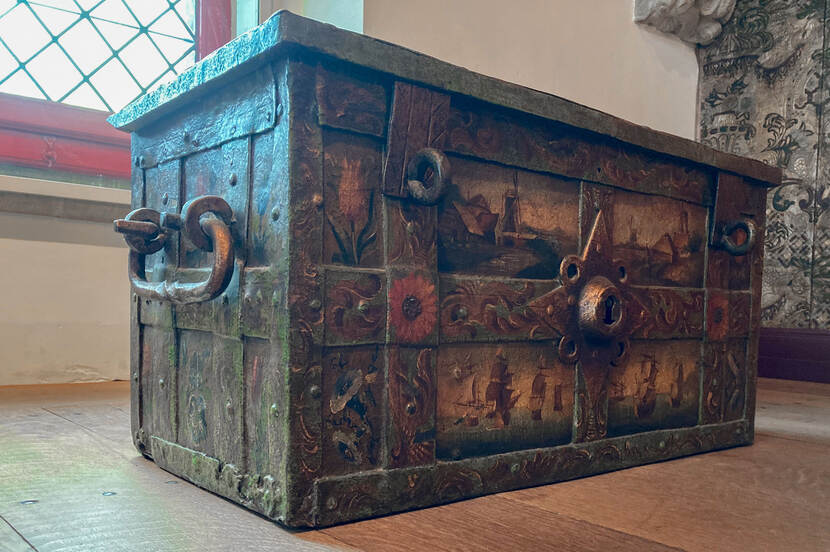
The Dutch Cultural Heritage Agency (RCE) is investigating many objects in the Dutch NK collection whose ownership is unknown. (NK works were retrieved from Germany after the war and brought back to The Netherlands.)
The chest, NK 245, measures 41 (h) x 76 (w) x 38 (d) cm, is covered in polychrome paint richly decorated in many shades of green and yellow. Dutch scenes with ships, landscapes with trees, windmills and haystacks are surrounded by tulips and other flowers on the lid and front plate. An inscription on the metal band on the lid reads: ‘Whoever saves finds something in the pot’, with the date ‘Anno 1691’.
The chest has a complicated closing mechanism with hidden keyholes and false panels and can only be opened by performing actions in a certain order. The contents are unknown, because it has yet to be opened. Money, jewelry and valuable papers can often been found in this type of chest.
It was taken to Germany during the occupation of the Netherlands and returned on 10 July 1946.
If you know to whom it belongs or have any additional information on this chest, please contact restitutie@cultureelerfgoed.nl.
23 February 2023: There are several unanswered questions hanging over the Dutch Restitutions Committee, despite it now being almost one month since the sudden and dramatic resignations of the Chairman Jacob Kohnstamm and Vice-Chairman Els Swaab over an "internal matter".
A former State Secretary, Jacob Kohnstamm was the chair of the government-appointed Evaluation Committee which created 'Striving for Justice', the new restitution framework in the Netherlands adopted by the Dutch government. In September 2021, he was appointed chairman of the Restitutions Committee. To the outside world, his appointment and that of Els Swaab represented the unambiguous commitment of the Dutch government to implement in full that new framework and approach.
Since 2021, under its new leadership, the Restitutions Committee had flourished and provided the transparent and thoughtful decisions that did much to restore confidence within the international community in the fairness and justice of the Dutch restitution process which had previously been fundamentally eroded.
However, the still unexplained resignations have had a damaging impact both nationally and internationally on the trust that is esential to the restitution process in the Netherlands. Claimants are concerned about how their cases will be handled; they are reluctant to submit to what is now an opaque process in an uncertain framework; and the suggestion, made last week, that new appointments will be made, but outside any timetable, leaves the Restitutions Committee in effective limbo for months to come.
The chair and vice-chair were central to the restored faith in the Netherlands restitution process. It is essential that there be an explanation of what occurred and how an "internal matter' was allowed to destroy the international confidence that had been rebuilt with such care over the last three years.
Following the sudden and unexplained resignations of the Chair Jacob Kohnstamm and the Vicechair Else Swab announced last week, the Restitutions Committee has issued another statement. Jacob Kohnstamm was not only the Chair but also the Chair of the Evaluation Committee which created the new assessment framework, and his departure has raised grave concerns. The statement is reproduced in full below:
'Restitutions Committee sets course and carries on working flat out
Following the recent departure of two of its members, the Restitutions Committee (RC) is taking all possible steps in order to continue its task of striving for the restoration of rights relating to art that was lost involuntarily during the Nazi era.The current substantive approach will be maintained.
The Ministry of Education, Culture and Science (OCW) is giving priority to filling the vacancies in the RC that have arisen (see Appointment of RC members below). In the interests of continuity, the independent RC is continuing its activities unabated. State Secretary for Culture and Media Gunay Uslu attaches great importance to this.
So that the RC can continue its work without delay after the departure of two of its members, lawyer and former notary Dick Oostinga has taken on the task of vice-chair, supported by the other committee members. The RC currently has five members. At least three members are required for handling cases, including the chair or vice-chair.
Committee takes comments seriously
The RC understands that the departure of two members referred to above can give rise to questions about the course it is following, and it takes comments about the issue seriously. The departures relate to an internal matter that the RC cannot discuss in the interests of due care. It explains the course it is following in more detail below.
A critical evaluation of the restitution policy in 2020 by the Second World War Nazi Looted Art Restitution Policy Evaluation Committee resulted in significant changes, which the RC welcomed and has meanwhile implemented. These changes were aimed at uniform and clear decision making, and an open and engaged approach to restitution applicants.
New assessment framework
The advisory report Streven naar Rechtvaardigheid (Striving for Justice) was prepared by the Evaluation Committee after consultation with, among others, the members of the Restitutions Committee. They furthermore contributed to the drafting of the new assessment framework, which has been in force since 22 April 2021. In it, for example, there is no longer a defensible step of weighing up interests as part of the substantive handling of restitution applications.
This assessment framework continues unchanged as guiding and determining in the preparation of recommendations and rulings. In accordance with the Washington Principles, assessment is aimed at reaching ‘a just and fair solution’.
Appointment of RC members
The Decree Establishing the Restitutions Committee states that the RC may have a maximum of seven members. The State Secretary of OCW appoints the members of the RC and its chair. The State Secretary is supported in this by an appropriately qualified appointments advisory committee. The RC itself has no influence on the appointment process.
Candidates must comply with specified profiles that contain the requirements. Advertisements in widely read daily newspapers invite candidates to apply. The Ministry of OCW has meanwhile initiated preparation of the recruitment process for filling both of the vacant positions.
We will keep you informed about progress with the procedure.'
4 February 2023: Last week, AP together with various other news agencies and outlets reported the apparent 'good news story' that Spain had ‘returned' to Poland two Nazi looted paintings seized in Warsaw in 1941.
The paintings, a diptych attributed to the 15th century Flemish painter Dieric Bouts, Mater Dolorosa and Ecce Homo, had been located in the Pontevedra Museum in Galicia which acquired them in 1994 from a Spanish private collector. The first documented reappearance of the paintings after the war had been on the Madrid art market in in 1973 when they were acquired by the private collector.
In 2020 Polish officials made a claim for the paintings and the museum decided to send them back to Poland. This took place once the Spanish government issued the export permits.
The slightest effort to check the story would have shown that the paintings do not belong to Poland but to the Czartoryski family whose entire Gołuchów collection was seized by the Nazis in 1941. The seizure of the collection was famously described and given as an example of Nazi art plunder by the American prosecutors at the Nuremberg Trials in 1945-6 where art looting was prosecuted as a war crime.
There could have been no doubt in Spain or Poland about the rightful ownership of the paintings which are published by the Polish government’s Ministry of Culture and National Heritage both in volumes of wartime losses and in their online database as owned by the Czartoryski family collection of Gołuchów.
Checking the story would also have shown that the Polish government’s claim for the paintings was in contravention of the rights of the family, the rightful owners, whose agreement was never sought by Poland. On the contrary, the family were forced to seek the support of other European governments and make a counter-claim to prevent this second expropriation of their paintings.
However, Spain, like Poland, decided to ignore the family’s ownership rights, as well as the Washington Principles which require Nazi looted artworks to be returned to their individual owners, and agreed to ‘return’ the paintings to Poland. This ‘return’ contravenes both the Washington Principles and the Terezin Declaration as well as all other post-war commitments and laws. It is to be hoped that no other country or institution will enable the Polish government, whose attachment to the rule of law is notoriously fickle, to abrogate the rights of private individuals to seize their property and take it to Poland.
The rightful owners, whose legal challenge was ignored by the Spanish authorities, said: ‘It is sad to see that eighty years after the paintings were seized, the governments of both Spain and Poland show no regard for the rights of individuals'.
Jacob Kohnstamm, chair, and vice-chair Els Swaab have submitted their resignations to Gunay Uslu, the Dutch State Secretary for Culture and Media, 'due to an internal matter'. The State Secretary announced that Dick Oostinga, a lawyer and former notary, and a member of the Restitutions Committee since 2018, has been appointed Vice-Chair with immediate effect and will supervise the Commitee temporarily to 'enable the independent Restitutions Committee to continue its important work, to which the State Secretary attaches great importance, without interruption. The State Secretary is responsible for appointing committee members and she will initiate the process of selecting a new chair and a new committee member in the near future.' The State Secretary noted: 'The Restitutions Committee will do everything it can to continue to discharge its tasks in full. I would like to stress that the policy, as amended in 2021, will continue to serve unchanged as the Restitutions Committee’s guiding principle'. It was Jacob Kohnstamm who chaired the Evaluation Committee which created the amended policy and assessment framework in 2021.
The latest Newsletter, produced by Germany's Advisory Commission, focuses on Switzerland with four special articles: a report on the Schweizerischer Arbeitskreis Provenienzforschung (Provenance Research Association) set up in 2020 and its two sets of guidelines for provenance research published at https:// www.museums.ch/publikationen/standards/; information about a new research project at Zurich's Swiss Institute for Art Research on 'Players in the Swiss Art Trade' to be published in 2026; an Interim Report on the Round Table on the Evaluation of Bührle Collection Provenance Research; and an article 'Taking fair and just decisions based on findings leading to an incomplete or uncertain state of evidence: The decision of the Kunstmuseum Bern in the restitution claim asserted by the heirs of Dr. Ismar Littmann'
The body of the Newsletter has extensive other news and information, including news of five Austrian restitutions (with case studies) and of two Dutch restitutions (to the heirs of Johanna Margaretha Stern-Lippmann and of Emma Budge); this year's programme of seminars at Paris's Institut national d‘histoire de l‘art (INHA), news of the forthcoming important Lost Lift database showing confiscations and auctions of Jewish property at the ports of Bremen and Hamburg which will be online in spring in German only initially; details of another German government funded restitution practice project, this one at Frankfurt's Europa Universitát Viadrina, to investigate the restitution principles practised in the post-war period and their afterlife in today's German Guidelines with the aim of 'providing fresh impetus for how restitution procedures can be handled in future' and 'to systematically record current uncertainties in applying the verification guidelines and to analyse historical case law concerning reimbursement issues ..in order to produce a commentary on the Guidelines'; and a report on the April 2022 symposium “The spoliation of musical instruments in Europe, 1933-1945”.
To read the Newsletter, please see here.
The 1.7 million records were made available to MyHeritage by the Israel State Archives and include all surviving records of all those who immigrated to Palestine and, from 1948, to Israel by ships and planes from all over the world from 1919 onwards. All the records were scanned and a searchable index created. The collection is available for all to search and view for free; there is no obligation to sign up to MyHeritage.
The records include the name of the immigrant and the names of relatives who immigrated with them, country of origin, the name of the ship they arrived on, the date of arrival, names of parents, names of relatives who were expecting them in Palestine/Israel, and their destination city. The records also include the arrival of tourists, or the return of Palestine/Israeli residents from a trip abroad. Pedestrian arrivals are also listed, i.e. those who came in through border crossings in the north or south.
Although most of the data in the collection is in Hebrew, MyHeritage’s Global Name Translation Technology™ allows the collection to be searched in English and other languages. The names in the records found will be transliterated back to your language for your convenience.
To search the records, go to https://www.myheritage.com/research/collection-11018/israel-immigration-lists. To see examples of the possible searches, visit here.
12 January 2023: Christie's have announced 'a year-long global programme of events spotlighting the history and vital work of restitution'. Their press release records that '2023 marks the 25th anniversary of the Washington Principles – an international agreement that opened a new era of transparency with respect to art lost or stolen during the Nazi period between 1933 and 1945. Throughout the year, Christie’s Restitution Department will honour this landmark moment with Reflecting on Restitution, a global programme of events. During 2023, scholars, legal experts, researchers and interested parties will meet in Paris, Amsterdam, Vienna, Berlin, London, New York as well as throughout the United States, and Tel Aviv, to share and discuss important stories, ideas and perspectives.
Christie’s Reflecting on Restitution programme begins on 27 January, when visitors will be welcomed to an inaugural public exhibition by French contemporary artist Raphaël Denis, held at Christie’s galleries on Avenue Matigno, Paris. The exhibition will feature a series of installations that form an extremely precise fragmentary reconstitution of artworks lost to confiscation, looting, or forced sale by Jewish collectors in France. To mark the opening, Christie’s will host a panel discussion on the Washington Principles and on post-war restitution efforts, including presentations by leading experts David Zivie, Head of France’s Mission for Research and Restitution of Spoliated Cultural Property between 1933 and 1945, and art historian Emmanuelle Polack, together with Claire Gimpel Touchard, descendant of René Gimpel, Didier Schulmann, emeritus curator, and the artist Raphaël Denis.
Throughout the year, global audiences will be invited to engage with the programme through other in-person opportunities as well as Christie’s dedicated website, featuring recordings of selected events, stories of important restitutions, as well as a virtual walking tour of historic sites throughout Berlin. For further details and the calendar of events, see here.
The newly launched website of the French Ministry of Culture's Mission de recherche et de restitution des biens culturels spoliés entre 1933 et 1945 (Mission for the Research and Restitution of Cultural Property Spoliated between 1933 and 1945) contains extensive information about research and restitution of cultural property, documentation and other research tools in France at www.culture.gouv.fr/spoliations-restitutions-1933-1945.
Sections include Request for restitution or compensation, Looted cultural property, Cultural property MNR and Base Rose Valland (MNR-Jeu de Paume), Historical and legal documentation, Provenance research, tools and method, Museum and library professionals. Within each section are further defined areas explaining laws, process, procedures and definitions, and providing resources, databases, bibliographies, contacts and other valuable information.
The pages of the site are in French with automatic translation into English and German and other languages. For full details of the Mission and the website, click here.
The online journal transfer is an academic publication platform in the area of provenance research and the history of collections, as well as adjacent fields of investigation including art market studies, reception history, cultural sociology, or legal history.
It has issued an open call for submissions in English or German for the second annual issue on the following topics: Translocation of art and cultural assets; Art and cultural property law; Culture of remembrance, Cultural identity, Collective memory; Collections, History of collections; Art trade, Art market studies; Art policy; Sociology of art, Cultural sociology; Restitution, Return, Repatriation; Provenance research on individual objects or object groups.
For full details, click here.
94 files with a total of around 80,000 pages, primarily bidding, purchase and expert opinion files of the Düsseldorf art collections from 1933-1945 in the City Archives (Stadtarchiv Düsseldorf) were examined and of these more than 70 files have been indexed and scanned to enable full provenance research. Correspondence with foreign museums and other archival records important for provenance research, such as acquisition files from the 1920s that are directly adjacent in time, were also processed and made searchable in detail. Records include those of the Department of Culture and the Mayor, and extend beyond the Rhineland. They show, for example, connections to the occupied territories of the Netherlands and France at the beginning of the 1940s. "It is a milestone to now be able to search the Düsseldorf files for people, art market institutions, artworks, places, events such as auctions or even subject-specific keywords, independent of time and place. In many cases, they offer information that one would not necessarily have expected to find in the Düsseldorf files," said Jasmin Hartmann, head of the Coordination Office for Provenance Research in North Rhine Westphalia.
The overview of the files is accessible here and the keyword search is accessible here. For full details see here.
At the launch of Geert Sels's book Kunst voor das Reich (Art for the Reich), Belgian Minister for Science Policy Thomas Dermine announced two initiatives. The first is an independent project by the Université Libre de Bruxelles (ULB) and the Technical University of Berlin with the Belgian State Archives who are working with the Museum of Fine Arts of Brussels to develop a methodology for provenance research in the museum's art collection.
Separately, Dermine is setting up a government-funded centre of expertise for provenance research. Its mission is to actively search for the provenance of works of art. This applies to both colonial looted art and Nazi looted art. The centre will be housed in the Royal Institute for Art Heritage in Brussels (KIK-IRPA).
All statements, speeches and sessions at the Conference have now been published or are available on this site and on YouTube - links are on our Conference webpage here.
Ambassador Robert Řehák, chair, in his Closing Statement recorded that while “the Terezín Declaration established both a goal and a benchmark that drew attention to the needs of survivors and encouraged governments to move forward. There is no doubt that much restitution and compensation work remains to be done in some countries and, with sufficient political will, can and must be done”.
With regard to looted art the statement said: "The need for continued provenance research and the difficulty of matching looted art with original owners and heirs, as well as the reluctance of institutions and individual owners to surrender their holdings, has very much limited the implementation of the Washington Principles on Nazi-Confiscated Art which were reaffirmed and broadened in the Terezín Declaration and at this November 2022 Conference. States were urged to implement those Principles as well as to advocate for their adoption in general. Other forms of looted Jewish movable property including religious objects and cultural property have also not been adequately identified and efforts to return them to their communal or individual owners have often been blocked. These are important elements of Jewish heritage, and participants emphasized the need for urgent action to be taken to resolve this issue and to provide in rem restitution or compensation through a process that is expeditious, simple, transparent, and non-discriminatory”.
All statements, speeches and sessions at the Conference have now been published or are available on this site and on YouTube - links are on our Conference webpage here.
Videos of all the discussion panels and national statements can also be found on the website of the conference: https://www.mzv.cz/terezindeclaration
The 98-page suit filed by the heirs of German Jewish banker Paul von Mendelssohn-Bartholdy against Sompo Holdings et al in the Illinois District Court on 13 December is available here. The heirs claim that Mendelssohn-Bartholdy relinquished the painting in Berlin in 1934 as a result of Nazi persecution and that Sompo Holding’s corporate predecessor – the Yasuda Fire and Marine Insurance Company – acquired Sunflowers at auction in 1987 in reckless disregard of the Painting’s provenance, including Mendelssohn-Bartholdy’s forced sale of the painting in Nazi Germany in 1934.
The entire conference was recorded on video and the lectures are now available through the Goldstein-Goren Diaspora Research Center’s YouTube Channel here. The full programme of the event as well as the biographical notes of the conference’s participants are available here.
The suit was filed by the heirs of Hedwig Stern who was forced to flee Munich to California at the end of December 1936 and was barred by the Gestapo from taking her artworks with her which were then sold by Nazi appointed agents. One was a Van Gogh acquired by the Metropolitan Museum New York in January 1956 and subsequently sold by the Museum in May 1972 to Basil and Elise Goulandris. The complaint seeks restitution, injunctive relief, damages and punitive damages for recovery of personal property, restitution of unjust enrichment and conversion. To read the suit, click here.
The World Jewish Restitution Organization (WJRO) has announced the publication of an extensive report that presents a historical analysis and partial list of cultural objects looted from Jews and others by the Croatian fascists – the Ustaše – during the Holocaust and after World War II, that were nationalized by the Communist government and distributed to Croatian state institutions. The report was completed in 2020 based on the archives of the KOMZA (Commission for the Gathering and Protection of Cultural Monuments and Antiquities) that were made accessible the previous year by the Ministry of Culture of the Republic of Croatia.
The report is now being released in cooperation with the Croatian government and WJRO. It was originally scheduled to be released in 2020 but was delayed partly due to the COVID-19 pandemic and to the 2020 earthquake in Zagreb. The Croatian Ministry of Culture has recently established an expert group on provenance research. A process for claims has yet to be established.
For full details and to read the report, please click here.
Published this time by the German Advisory Commission, the editorial, 'Taking on Historical Responsibility', focuses on similar cases having given rise to divergent decisions at national and international level in relation to Fluchtgut, or flight assets. The authors note that "there is still no generally accepted definition of the term" and "the question of how to deal with “flight assets” remains extremely controversial to this day... even where cases are supposedly of a similar nature, it has not yet been possible to elaborate criteria for establishing comparability". Nor do the 1999 German Guidelines mention the conditions under which such a legal transaction is to be considered the result of Nazi persecution. Hence "it is regularly up for discussion as to whether the causal connection between persecution and sale is sufficient to justify restitution – whether or not an item was sold as a result of economic hardship caused by forced emigration, for example." The authors' view is that the focus on the economic situation of the seller is "morally dubious". They conclude:
"The term “flight assets” invites us to take a more fundamental perspective: where does National Socialist persecution begin and where does it end? Didn’t such persecution also have a broader impact, not just across borders but also over the years? But does this make the search for a transnational, European consensus in dealing with persecution more plausible? Wouldn’t this suggest comparability at the price of historical accuracy? Different countries had starkly differing roles to play with regard to National Socialism – first and foremost Germany, of course. The fact that the various countries today respond in different ways here does not seem to be a violation of a postulate of equality: it is simply the taking on of historical responsibility, something which may vary according to place and time. This can hardly be reflected in a set of Europe-wide rules.
By restituting cultural property, we address the past, but even more the present: we are seeking to make a difference today. Our aim is to admit to those who were persecuted that traumatisation can continue for generations, and that for this reason, healing may be called for generations later, too. We are endeavouring to be a society that deals with the past differently than used to be the case."
The wider contents of the Newsletter include information on new research resources and publications, recent decisions in the Netherlands and elsewhere, recent restitutions, case studies, reports on conferences, on the use of language in dealing with Nazi-looted art, on the Max Ginsberg Collection research project, on the OFP (Oberfinanzpräsident) Berlin-Brandenburg Project on the 42,000 files of the Nazi Vermögensverwertungsstelle(Property Liquidation Office), each on a victim of the Nazis. The files document how the Nazi state liquidated confiscated property for the profit of the state treasury and the project focuses on the art and cultural assets mentioned in the files.
The Newsletter includes much else from a range of countries. For full details and to read the Newsletter, click here.
A new research group dedicated to provenance research and restitution of looted art in the Netherlands has been founded under the coordination of Professor Dr Gregor Langfeld at the University of Amsterdam's Faculty of Humanities. The 35 members of the group include government, museum, art trade personnel, claimants and independent researchers. As an inclusive research group, they are interested in a variety of approaches: "apart from applied provenance research and juridical restitution, we address memory, holocaust and genocide studies, and museological, curatorial and cultural heritage perspectives". Its main goal is to organize lectures, expert meetings and discussions on a regular basis, about ongoing (PhD) research and other current issues. For full details, please click here.
A table of the paintings recorded in the Reichskunstdepot Kremsmünster ("K numbers") is now available on the website of Leonhard Weidinger at https://leonhard.weidinger.wien/daten/kremsmuenster-gemaelde. The source of the information is BDA-Archiv, Restitutionsmaterialien, Kiste 13-4, Mappe 14 and the transcription of the list is supplemented with data such as origin, time and destination of removal, Iv numbers, Mü numbers, etc. Kremsmünster Benedictine Abbey in Upper Austria, founded in 777, was seized by order of the Gestapo in 1941 and placed under the administration of Reichsgau Oberdonau (Upper Danube). The first and largest transports of seized paintings from Austrian collections took place in May and June 1941, and continued until 1943. From summer 1941 it was also used to store artworks for the "Sonderauftrag Linz" - between August 1941 and November 1943, 1,732 paintings were transferred from Munich to Kremsmünster. For full details of the history of the Depot, see the Austrian Lexikon for Provenance Research article at https://www.lexikon-provenienzforschung.org/en/kremsmunster-reichskunstdepot.
The Provenance Index Remodel project recently published updated versions of the Knoedler Stock Books, Groupil Stock Books and Sales Catalogs datasets on GitHub. Major changes include German sales data from auction catalogs published in Austria, Germany, and Switzerland between 1900 to 1929 that were added to the Getty Provenance Index in June 2019. The new datasets also reflect additional cleaning and normalization work in support of the ongoing remodel of the databases as Linked Open Data. More about the Getty Provenance Index Remodel can be found on the Getty Research Institute site here.
The new state regulation, signed into law by Governor Hochul, requires museums to instal placards or other signage alongside works on view that were looted by the Nazis during the Second World War. For further details and the full text of the legislation, please click here.
On 5 August 2022, Arts Council England released new guidance for museums on restitution and repatriation devised with the assistance of the Institute of Art & Law. The new guidance offers guidelines, best practice and case studies for the museum sector, helping institutions act appropriately and considerately in the context of claims for the return of collection objects. It replaces previous guidance on the topic that had been published by the Museums and Galleries Commission in 2000. For full details and to read the Guide, click here.
In January 2018 the Dutch Restitutions Committee rejected a claim for the painting, in Eindhoven's Van Abbemuseum, on the grounds that it had not been proved the loss of the painting was during the Nazi regime. New facts which emerged from correspondence and lists of artworks not previously known to the Committee led to the reopening of the case and gave the Committee reason to conclude that it was plausible that the painting ceased to be in the possession of Margarethe Stern-Lippmann during the Nazi regime.
The art dealer Karl Legat had sold the work to the Eindhoven City Council in 1951. The Van Abbemuseum’s inventory card read 'previously the collection of A. Kaufmann; whose daughter living in the Netherlands sold it to Légat' (Stated by Légat). New research showed it was improbable that Legat purchased the work from Kaufmann or his daughter, and extremely unlikely that Kaufmann ever possessed the work. The purchase price that Legat allegedly paid to Kaufmann’s daughter also indicated that Legat did not acquire the work until after the war, while the Kaufmann family left the Netherlands before the occupation.
Other newly submitted documents showed that until 1952 the family assumed that the Kandinsky was still in their possession and only discovered it wasn't in June 1952 when a valuer investigated. On the grounds of that information, the Committee considered it unlikely that the work ceased to be in the family’s possession after the occupation.
Other newly unearthed documents include a postcard of the painting that art dealer Myrtil Frank’s wife sent to a third party in 1966 on which she wrote: ‘This was our Kandinsky’. During the war her husband was involved in obtaining works owned by Margarete Stern-Lippmann which make it plausible that the Franks got their hands on Blick auf Murnau mit Kirche at some point.
On those three grounds, the Committee concluded that it was plausible that the work did not leave the possession of Margarethe Stern-Lippmann before the occupation, that the family did not sell it after the occupation, that Margarethe lost possession of it during the occupation, and that it came into the possession of the Franks. On the grounds of criterion 3.1 of the assessment framework, the Committee therefore assumed that her loss of possession was involuntary.
To read the recommendation in full, please click here.
Böhler re:search is a digital edition of the archive of the art dealer Julius Böhler of Munich. Active since 1880, and operating in Munich, New York, Lucerne and Berlin, Böhler was one of the most important art dealers in the German-speaking world. With an international reputation, his customers included museums, collectors, and art and antique dealers. The database provides information on the approx. 18,300 works of art traded at Böhler between 1903 and 1948 and on the almost 9,900 people involved in the transactions. Böhler was very active during the Nazi era, dealt in looted art, and the material is of outstanding importance for the search for such works. For full details of the database and to access it, click here.
The latest additions to the Lexicon of Austrian Provenance Research are now online. 14 new contributions have been added - Ferdinand Bloch-Bauer, Lea Bondi-Jaray, Dorotheum, Alice Friedländer, Othmar Fritsch, Arnold Harding, Galerie Harding, Albert Klein, Eduard Nierscher, Adalbert Parlagi, Rudolf Prinz, Adolf Proksch, Gezá Radó and Helene Silverio - bringing the total entries to 349, in both German and English. The entries are linked to Wikidata as far as possible. To visit the Lexicon, go to https://www.lexikon-provenienzforschung.org/en
If you have any comments on contributions to the encyclopedia, please email: konstantin.ferihumer@leopoldmuseum.org, susanne.hehenberger@khm.at or leonhard.weidinger@mak.at.
The next update is planned for the end of the year.
Posted by the Leo Baeck Institute Jerusalem:
Our library contains about 13,000 books, most of them are old and have traveled far before they reached our shelves. With the help of the traces that former owners left inside these books, we can learn more about the books’ journeys from Europe to Jerusalem.
To allow analyzing this valuable information, we are now starting to document the ownership marks of the books in our collection. Because provenance research is such a complex task, especially if it comes to tracking Nazi-looted books, it requires a joint effort. Therefore, we joined the cooperation Looted Cultural Assets (LCA), a group of libraries founded in 2016 in Germany.
We are proud to be the first institution from outside Germany to join the cooperation. The results of our documentation work, and the provenance data of our books, will be publicly available via the online database of LCA. This database already contains more than 32,000 provenance marks and information on more than 10,000 persons and institutions. It is available online for research free of charge.
Read more about LCA here:
https://bit.ly/3yYCpXd
Check out the LCA database here:
https://bit.ly/3Pb5wxk
Including details of the new Klimt database to be launched on 20 September 2022. For full details of the programme of lectures and to watch them, visit https://lootedart.com/VHPTRF389121
The Leo Baeck Institute (LBI) Jerusalem has completed the digitizing of their archival collections: over 700 archival collections and about 100 audio interviews are now available online.
The archive of the Leo Baeck Institute Jerusalem contains hundreds of personal, family and institutional collections documenting the lives of Central European Jews, both in their countries of origin, as well as in their countries of immigration. Among the archival materials are memoirs, diaries, official documents, letters and photographs. Most importantly for the purpose of provenance research: many collections document the histories of families. Thus, the archive can provide information when trying to identify a former owner that a provenance mark relates to, or when searching for family members of that former owner who emigrated to Israel.
For the same reason, the Austrian Heritage Collection of the LBI Jerusalem is also relevant to provenance research. It includes over a hundred audio and video interviews with Israelis of Austrian origin on their experience before and after leaving Austria following Nazi occupation.
Newspaper sources for provenance research include the Mitteilungsblatt of the Irgun Olej Merkas Europa, the German language newsletter of the association of immigrants from Central Europe. The LBI Jerusalem holds an almost complete collection, spanning the years 1932 until 2005, which is now being digitised.
To search through the digitized archival collections of LBI Jerusalem, click here
For full details of the LBI Jerusalem on this site, see https://lootedart.com/VJRWUM480981
Published by the Center for Advanced Holocaust Studies at the US Holocaust Memorial Museum in 2003, the book includes chapters on the the Finanzamt Moabit-West and the Development of the Property Confiscation Infrastructure, 1933–1945, the Supervision and Plunder of Jewish Finances by the Regional Financial Administrations, the Activities of the Haupttreuhandstelle Ost, the Seizure of Jewish Property in Romania, the Expropriation of Jewish Emigrants from Hessen during the 1930s, the Confiscation of Jewish Real Estate and the Plundering of Antwerp's Jewish Diamond Dealers 1940-1944. For full details of the contents and link to the book, see here.
The latest edition of the Newsletter includes a message from Claudia Roth, the new German Minister of State for Culture and Media, and from the 2022 German chair of the Committee, Hans-Jürgen Papier, chair of the German Advisory Commission.
In an important editorial 'Towards a Restitution Law' by Benjamin Lahusen and Gesa Vietzen of the Advisory Commission, they write that they are not in favour of a new German law on restitution, as proposed in the government coalition agreement, because "The conflicts of the present do not result from any lack of legal clarity: they derive from differing interpretations of the facts. For this reason, it is much more important to systematically record and reflect on existing uncertainties than to enhance the legal status of this practice. The consequence of a legal regulation would probably not be initially to provide a clearer definition of what is a “just and fair” solution but mainly to put the responsibility in the hands of lawyers. The involvement of legal representation has indeed become necessary on many occasions in the past, even without there being any legal basis. To what extent the former owners and their heirs are encouraged by this development to come forward and make known their claims, as called for in Principle 7 of the Washington Declaration, is questionable."
They continue: "the intended task of the Commission has been to broaden the view of moral and ethical aspects in designated individual cases where it has not been possible for the parties themselves to arrive at a solution based on the Guidelines, with the aim of introducing new perspectives regarding potential solutions. This is an approach that has sought to achieve mutual understanding, compromise and reconciliation, but which has often encountered difficulties in practice due to the hardened positions expressed in lawyer-led lines of reasoning. It can therefore hardly be assumed that the judgement of a purely judicial body would have a satisfactory impact on those involved and on society at large in the interests of promoting reparation in the long term."
"Since restitution – whether by legal process or not – is largely based on the criteria of Allied legislation during the post-war period, it seems almost imperative to us to start with a historical review of the case law of that era and to relate this to current procedures as set out in the Guidelines. The scope for definition offered by the Guidelines allows differing interpretations whose respective justification can only be clarified based on interdisciplinary scholarly support. Among other things, one recurring problem that arises when reaching a decision on a restitution application is how to deal with gaps. Following the fourth principle of the Washington Declaration, the Guidelines also state that these are unavoidable. The parties can use so-called prima facie evidence as an alternative form of proof. But beyond this, a discussion is also required of how far the lack of clear facts impact on the stipulated criteria – for example on the principle of priority, which continues to apply. In our opinion, the explanations of the criteria also have to be put into historical perspective and reviewed with regard to current research findings. Knowledge of the structures of Nazi injustice is continually expanding"
To read the rest of the Editorial and the Newsletter which includes a range of articles on individual cases and various provenance research projects, please click here.
.
Edited by Elisabeth Gallas, Anna Holzer-Kawalko, Caroline Jessen and Yfaat Weiss, and published in 2020, the book includes chapters on books and libraries, émigré collections, archives, paintings, and the rebuilding of Jewish culture in Europe. For full details of the contents and link to the book, see here.
Yerusha and Judaica Index are online portals to digital resources on Jewish cultural heritage developed by Rothschild Foundation Hanadiv Europe
Yerusha.eu is an online catalogue providing extensive information on European Jewish archival heritage. It features more than 12,000 in-depth archival descriptions from 700 European archives, libraries, and museums in 27 countries, providing access to archival records covering all major subjects of Jewish history. The database describes Jewish and Jewish-related collections from a wide range of holding institutions across Europe, from Jewish communities to national state archives.
JudaicaIndex.org is a comprehensive inventory of 200 Jewish ritual objects found in synagogues or Jewish homes around the world. Each individual object page includes a brief description of the item and its use, curated images from over 50 collections, references to collections and online catalogues, a specialised bibliography, a video, and navigation options that encourage both targeted research and discovery. One of the unique features of Judaica Index is the multi-lingual search function available in 15 languages (English, French, German, Italian, Spanish, Dutch, Polish, Czech, Hungarian, Greek, Russian, Hebrew, Arabic, Ladino, and Yiddish). Users can search by object name or keyword and the entries will be regularly enriched and updated. It is an invaluable tool for researchers and anybody interested in Judaica from all over the world.
These registers– two sales registers and one purchases register–constitute the newest addition to the Galerie Félix Gérard and Galerie Raphaël Gérard Records released at the end of 2021 on the WPI’s Digital Archives.
Born into a family of art dealers, the French gallerist Raphaël Gérard (1886-1945) opened Galerie Raphaël Gérard at 4 avenue de Messine in Paris around 1932. Though they specialized in the Barbizon school, Impressionists, and contemporary masters, they also bought and sold paintings by Caravaggio, Veronese, or Rubens. At the time, the gallery was an important place of business, as works of art moved across Europe to new owners in the United States at an unprecedented rate.
The stock books provide critical information for provenance research on the works of artists bought and sold by the gallery between 1937 and 1945. See here for further details and to access them.
IFAR (International Foundation for Art Research) has posted the video of their April 27th programme on Ukraine on their site here.
In the news section of their website, they have also posted and updated an important resource: Ukrainian Cultural Heritage Preservation and Humanitarian Aid Organizations — a Selected List, which includes links to initiatives and organizations working to protect the art, museums, and monuments of Ukraine, as well as to humanitarian organizations.
Recordings of the 12 lectures given at the 7 October 2021 symposium on 'Der Umgang mit Umzugsgut jüdischer Emigranten in europäischen Häfen' - ' The Handling of Removal Goods of Jewish Emigrants in European Ports' held at the Deutsches Schifffahrtsmuseum in Bremen are all now online on YouTube at https://bit.ly/3Mrgj5t. The full programme of the symposium can be seen here.
Since 2012, the Rijksmuseum has been conducting in-depth provenance research on the objects of its own collection with a team of five provenance researchers. Over the ten years more than 14,000 objects have been examined; reports on the research results are published on the museum's website. The museum collection can now also be searched by provenance name.
Portret van een Mogol-hoveling (Portrait of a Mughal courtier),
anonymous, c. 1640 - c. 1660
RP-T-1945-1
A recent subject of research is a miniature portrait drawing in the museum's collection since 1945, acquired from Werner Münsterberger (1913 Dortmund - 2011 New York), a German-Jewish art historian, ethnologist, collector and later psychoanalyst of James Dean. The sale was very likely a direct consequence of Werner Münsterberger's difficult living conditions during and immediately after the end of the war, which resulted from persecution by the Nazi regime. The provenance of the miniature portrait must therefore be regarded as problematic. The museum publishes all researched provenances in order to draw attention to gaps or queries and to create transparency. The decision on a possible restitution in the Netherlands is not made by the museums, but always by the Dutch Restitution Committee. To read more about the Rijksmuseum's provenance research and to contact the research team, click here.
At the UK Association for Art History annual conference, Laurel Zuckerman gave a presentation on the threat of post-plunder restitution fuelling an epidemic of false provenances and asked what, if anything, can be done to prevent these falsifications from permanently damaging the historical record. Societal context, motive and opportunity were identified as key factors, and the authors of false provenances —far from marginal players—identified as those who frequently occupy positions of trust, posing the threat of uncritical adoption of false information, and its spread throughout the entire network of provenance citations. She proposed the creation of a Registry of False Provenances and their Authors, not unlike efforts to track forgers. To view the video presentation, see https://youtu.be/61n1uZbASDE
An online exhibition on the vicissitudes of the Italian and Croatian synagogues and Jewish communities of Gorizia, Opatija, Rijeka and Trieste during the 20th century, focusing on the spoliation of Judaica during the Second World War. The documents reveal the continuous relationships between these four communities over time, with the same architects and studios, the same patrons and donors playing a role in constructing some of these synagogues, and with the Judaica sometimes transferred between them and reused as both liturgical and memorial objects.
During the war all the synagogues were either abandoned, occupied, damaged or reused. In all cases, their liturgical value was denied. Their contents (not only Judaica, but also furniture, current archives, everyday objects and office supplies) were burnt, pulped, smashed, sold or dispersed. Where possible, the exhibition traces their post-war fate.
Created by Daria Brasca and Donata Levi, both of the University of Udine, together the Italian team of the HERA project TransCultAA (Transfer of Cultural Objects in the Alpe Adria Region in the 20th Century), the exhibition includes previously unpublished photographs, contemporaneous documents and original materials on the history and pillaging of these communities and their post-war stories. There is a also an extensive bibliography for each community.
To visit the exhibition, click here.
The latest major update by Patricia Kennedy Grimsted of her ERR Archival Guide, 'Reconstructing the Record of Nazi Cultural Plunder: A Guide to the Dispersed Archives of the Einsatzstab Reichsleiter Rosenberg (ERR) and the Postwar Retrieval of ERR Loot', published in cooperation with the United States Holocaust Memorial Museum, has been announced by the Conference on Jewish Material Claims Against Germany (Claims Conference) and the World Jewish Restitution Organization (WJRO).
After the Second World War, the original ERR documents were widely dispersed and today are held in over 40 repositories in 10 countries. Dr Grimsted, the preeminent expert on WWII displaced archives, documents in this Guide the current locations of remaining ERR files and related sources, details their contents, and provides links to the many now online. The Guide also describes the subsequent fate, postwar retrieval, and restitution of ERR loot.
Highlights of the 353 pages of this updated German chapter include the greatly expanded English descriptions of three online groups of Rosenberg/ERR-related records in the Bundesarchiv (BArch Berlin-Lichterfelde): Bestand *NS 8 (Kanzlei Rosenberg), *NS 15 (DBFU), and *NS 30 (ERR), all now publicly available on the Internet with full digital texts through the BArch Invenio reference system.
Additional updates include several added repositories of interest; the new Federal Arts Administration (KVdB); extended Internet resources including library reports on NS-looted books; and an expanded bibliography of published literature, further extending research resources. Still featured are the online digitized records of postwar U.S. and German cultural restitution in Bestand *323 (TVK), with 75 files of digitized original ERR inventories and related documents directly linked to this chapter.
Along with the recently published update of the French chapter (December 2021), this newly expanded chapter on German resources should be helpful for much broader research on World War II looted cultural assets, not only for ERR seizures and ERR loot.
To see the Guide, click here.
The International Holocaust Remembrance Alliance (IHRA) comprising 35 member countries and institutions from those countries is focused on Holocaust education, remembrance and research worldwide and to upholding the commitments of the 2000 Stockholm Declaration and the 2020 Ministerial Declaration.
The newly published Guidelines call for open access to all relevant documents whether created or held at local, regional, national or international level, and say the deployment of privacy regulations should be balanced with the imperative of open research. Open-ended classification of documents is also a priority. The list of relevant documentation includes Ministry of Education files, Ministry of Interior and police files, flight records, property censuses, real estate ownership records, museum and library acquisition and other records, tax and notary records, documentation regarding confiscation, looting and disposession of property, and claims for restitution and reparations.
The Guidelines were drawn up with the advice and expertise of the European Archives Group (EAG), the European Board of National Archives (EBNA), the European Holocaust Research Infrastructure (EHRI) and the European Union Diplomatic Archives (EUDiA).
To see the Guidelines, click here.
Ukrainian art historian Konstantin Akinsha has created a site documenting the destruction at https://konstantin.akinsha.com/posts/ with daily posts on the latest attacks on cultural heritage. One of the most recent records the bomb damage on 7 March to a profoundly symbolic building in Kharkiv, a Constructivist-era residence known by the name 'Word', designed by Mytrofan Dashkevich in the shape of the letter 'C' - the first Cyrillic letter in the word 'CЛOBO' (slovo which means 'word'). The apartments were built for writers, artists and musicians in 1930 and among the residents were Mykhail Semenko, the famous Futurist poet; avant-garde artist Anatol Petrytsky, and Boychukists Ivan Padalka, and Vasyl’ Sedlyar. Many of them belonged to the Executed Renaissance and were killed during the Stalinist purges.
Video recordings of the papers given at the 7 October 2021 conference in Bremen on 'Der Umgang mit Umzugsgut jüdischer Emigranten in europäischen Häfen', 'The Handling of Removal Goods of Jewish Emigrants in European Ports' are all now available online on the Deutsches Schifffahrtsmuseum YouTube page at https://bit.ly/3Mrgj5t. The conference programme and details of each talk are given here where there is also the link to the recordings.
The Belgian Economic Ministry has launched a database containing records of 2,800 objects including paintings, sculptures, furniture and archaeological objects stolen by the Nazis in Belgium, both from private individuals and from public institutions.
The database, at https://lootedart.belgium.be/en/database-unrecovered-works-art-looted-during-second-world-war-belgium, is called 'The Database on the Unrecovered Works of Art Looted During the Second World War in Belgium' is published in Dutch, French and English. The site states that the works in the database are not necessarily identical to those lost; that they have not checked how many of the works of art have already been found and returned; that it should not be concluded that any object in the database was subject to loss; nor that the data in the database is accurate.
The information in the database is based on the original post-war claim declaration forms and other archival documents of the Department for Economic Recovery Service (DER - ORE) (1940-1968) - see here for the role of the Department and the details of its records.
60 works of art among those returned to Belgium after the war for the purpose of restitution, or found in Belgium at the end of the war, have been published on the websites of six museums in Belgium. To see those works which are all available for restitution, see Section 3 of Essential Website Links 2022 at https://lootedart.com/UN6RBO670361.
The latest major update by Patricia Kennedy Grimsted of her ERR Archival Guide, published in cooperation with the United States Holocaust Memorial Museum, has been announced by the Conference on Jewish Material Claims Against Germany (Claims Conference) and the World Jewish Restitution Organization (WJRO).
After the Second World War, original ERR documents were widely dispersed and today are held in over 40 repositories in 10 countries. Dr Grimsted, the preeminent expert on WWII displaced archives, documents the current locations of remaining ERR files and related sources, details their contents, and provides links to the many records now online. The Guide also describes the subsequent fate, postwar retrieval, and restitution of ERR loot.
The 421 pages of the updated French chapter greatly expand English-language coverage of the newly expanded online inventories of the files in the French Foreign Ministry archives regarding looted and displaced cultural assets not only in France but throughout Europe. These are now publicly available in the Centre for Diplomatic Archives in La Courneuve, near Paris. It's hoped that France will soon follow the example of Germany and other countries by making at least some of the most important already scanned files available over the Internet as Germany has already done.
A newly updated German chapter will follow soon. To see the Guide, click here.
Among events available to view online are recordings of most of the Insiders/Outsiders online events - on their YouTube channel- and the recent 'Looting, Loss, and Recovery: A Virtual Symposium' at the Jewish Museum New York which explored through seven sessions a range of topics related to their exhibition 'Afterlives: Recovering the Lost Stories of Looted Art' - also on their YouTube channel. The sessions feature Timothy Snyder, Lisa Leff, Sarah Abrevaya Stein and Rafael Cardoso.
The Europeana site gives access to explore and search more than 5 million newspapers from Austria, Estonia, Finland, Germany, Latvia, Luxembourg, Netherlands, Poland and Serbia. For the search page, click here.
In its latest recommendation, the Committee revisited a 2009 case that it had rejected, following the discovery of an extensive 50 year archive of Adelsberger family documents in the Jewish Historical Museum in Amsterdam. In 2009 the claim for two paintings was turned down on the grounds that ownership and the circumstances of loss of possession were not established. The family archive shows that the paintings were owned from 1933 by Alfred Isay, the son-in-law of Alfred Adelsberger (1863-1940), who took them to Holland in 1934, and that they were sold there in November 1941 by an intermediary for Isay. The Committee therefore recommended the return of the paintings on the grounds that 'Isay, who because of his Jewish background belonged to a persecuted population group, lost possession of the artworks involuntarily on 13 November 1941 by selling them through [the intermediary to a gallery] as a result of circumstances directly related to the Nazi regime'. To read the summary, click here. To read the full recommendation, click here.
The latest newsletter is published by the Dutch Restitutions Committee and includes a speech by Jacob Kohnstamm, the Committee's new chair, on 20 years of Dutch restitution policy, information about a research project on the Mauritshuis during the war, two case studies from Austria - the collections of Konrad and Anna Mautner, and of Robert Plowaty, two case studies from France - a painting owned by the Dutch couple Abraham Bargeboer and his wife Minna née Kirchheimer and two owned by Emile and Mathilde Javal. It also includes an addendum on 'the weighing of interests' by Matthias Weller and Tessa Scheller, a policy recently rejected by the Dutch, in which the authors assert that 'the weighing of interests is inherent to any notion of "justice"'. Weller heads a German government-funded project to 're-state' the Washington Principles, called 'Restatement of Restitution Rules for Nazi-Confiscated Art'. To read the newsletter, click here.
The database gives access to the Cornelius Gurlitt Estate, from any location and at any time.The inventory provides pictures of the front and back of every artwork, with basic data and current information about its ownership history (provenance). In the category of provenance status, the known history of owner-transfers is given according to the knowledge and standards of the Kunstmuseum Bern. The credit-line provides information on the current ownership status and the research status.The database will be updated as new information becomes available.
For full details and to access the database, go to https://gurlitt.kunstmuseumbern.ch/en/
Germany's Lost Art database has been re-launched as a purely object database. It is intended to provide better search options particularly for families searching for their looted property and to be a more up-to-date and user-friendly site. Launched in 2000, it now holds records of 180,000 items described in detail and of several million objects in summary form, from institutions and individuals both in and outside Germany.
The redesign has meant that all data other than that about individual artworks is no longer available. This includes the background provenance research information such as lists of owners, lists of auction sales, confiscation measures, resitution laws, German official commitments, etc. It is intended that this material will be transferred into the German Proveana site but lostart say it will take a great deal of time because of the work involved.
To access the site, go to www.lostart.de/de or www.lostart.de/en for the English language version and to read the press release see here.
The records document the activities of the galleries founded by Félix Laurent Joseph Gérard and later by his grandson Raphaël Louis Félix Gérard. The Belgium-born Félix Gérard opened a gallery in Paris where he traded works by major artists such as Gustave Courbet and Edouard Manet. The Galerie Raphaël Gérard was an important place of business during World War II which bought and sold many significant paintings such as Claude Monet’s Le Déjeuner sur l’Herbe and Paul Gauguin’s Christ Jaune. This collection includes administrative files from Galerie Félix Gérard and a large assortment of photographic reproductions of works from the Galerie Raphaël Gérard.
The Administrative Files 1899-1945 consist of invoices, receipts and letters from 1899 and 1900 addressed to Félix Isidore Laurent Joseph Gérard and to his father Félix Laurent Joseph Gérard. The Photographic Reproductions 1903-1959 contain ca. 2,800 photographs of paintings, drawings, sculptures, furniture, and decorative objects from the 15th to the early 20th c., with a strong focus on 19th c. paintings. To access the records go to https://digitalprojects.wpi.art/archive/detail/453312-galerie-felix-gerard-and-galerie-raphael-gerard-re
Launched on 3 December 2021, the Directory of Actors in the Art Market in France during the Occupation, 1940-1945, is published by France's Institut national d’histoire de l’art (INHA) in French and German (in English in spring 2022). It consists of more than 150 biographical articles, written by 70 international authors, drawing on numerous French and German archives, for the most part unpublished. These are supplemented by 830 purely factual accounts of individuals, companies and organisations. A joint project of INHA and the Technical University of Berlin, led by Inès Rotermund-Reynard and Elisabeth Furtwängler, the documents reconstruct the trajectories of people and artworks during this period by highlighting the complex networks through which they passed.
The site is at https://agorha.inha.fr/database/76
In December 2016, the German Advisory Commission made a recommendation about the claim by the heirs of Felix Hildesheimer for a 1706 Guarnieri violin then owned by the Hagemann Foundation in Nuremberg. In its first case involving a private institution, the Commission found that the violin was lost due to persecution and, as a fair solution, proposed that the violin, whose market value was ca. €150,000 with repair costs of ca. €50,000, remain in the Foundation and the Foundation pay €100,000 to the heirs.
In January 2021 the Foundation, which had earlier refused to pay the compensation, issued a statement disputing the finding that the violin was subject to loss due to persecution. The Commission responded by issuing a public statement condemning the Foundation’s actions as “not just contravening existing principles on the restitution of Nazi-looted art… [but] also ignoring accepted facts about life in Nazi Germany.”
Recently, following the completion of the violin's restoration, both parties asked the Advisory Commission to determine its value. Expert opinions gave an average value of € 285,000. The Commission has now issued an amended recommendation that the Hagemann Foundation pay €285,000 as compensation for the loss sufferered to the heirs of Felix Hildesheimer, noting that 'The fate of Felix Hildesheimer and his family and the loss of the instrument due to Nazi persecution is undisputed between the parties'. The amended recommendation is here.
The Claims Conference/WJRO has compiled a statistical review of the research results by the Taskforce Schwabinger Kunstfund as well as by the Gurlitt Provenance Research project. The graphs clearly exemplify that an organized and online accessible overview of all artworks that are part of the Gurlitt trove is still missing, including for artworks that are classified as “degenerate art” as well as for artworks with provenance gaps between 1933 and 1945.
The Gurlitt Provenance Research project focused on 682 so-called green, yellow, and red cases. As of November 2021, 682 case reports are viewable on the German Lost Art Foundation website. Among the completed reviews were 4 artworks that fell into the red category, 615 that were part of the yellow category, and 29 artworks that were categorized as green. The information on the results of the Gurlitt Provenance Research has appeared in different places. The Claims Conference/WJRO has therefore brought together all the online available information so as to allow searches for specific paintings in each category, red, yellow and green, with references in various websites.
The Claims Conference reviewed these results and found that 385 artworks were appropriately categorized as “yellow.” However, 155 artworks that were categorized as “yellow” should be reviewed again as most of these cases have one or more red flags referring to mentions of Nazi agents or art dealers who collaborated with the National Socialist regime.
The review also found that an additional 77 cases should be more appropriately categorized as “orange,” meaning that in these specific cases there are numerous red flags and prominent provenance gaps that suggest that they are between yellow and red. In particular, among the 77 cases are 54 in which a claim was filed. In other words, the Claims Conference believes that artworks with one or more red flags should be reviewed again.
For full details and to access the lists, click here.
The Ministry of Culture of the Russian Federation on its website entitled “Cultural Values-Victims of War” in a section on “Moved Cultural Values” has published a partial list of paintings, drawings, graphics, archaeological objects, musical instruments and other categories of objects that were brought into Russia by the Soviet Trophy Brigades at the end of World War II. Although parts of the website are in German, English, and French, the catalogue of the objects is exclusively in Russian. To make the listing better known to non-Russian speakers, the Claims Conference/WJRO has provided a translation into English by Yagna Yass-Alston of all the listings of paintings that are by known artists. For full details and to access the listings, click here.
The Encyclopedia of Austrian Provenance Research was launched at the end of 2018 as a German language online resource on individuals and institutions in Austria between 1930 and 1960. Its aim was to bring together the findings since 1998 of the Commission for Provenance Research and other provenance researchers on the seizure of art and cultural property during the Nazi era and on restitution practice in the post-war period. It has now been re-launched and re-designed as a bilingual resource in English and German, with more than 300 contributions on individuals and institutions in the fields of museums, cultural policy, collections and the art trade. The Lexicon will be continuously expanded and revised. To visit the Lexicon, go to https://www.lexikon-provenienzforschung.org/en
Available at delpher.nl, the word searchable resource was developed and is managed by the Koninklijke Bibliotheek (Royal Library), the national library of the Netherlands. It offers original texts from more than 1.7 million Dutch newspapers (1618-2005), 11 million magazine pages (1800-2000), 1.5 millon radio bulletins (1938-1989) and more than 900,000 books (17th-20th centuries), some 120 million pages in total, with more continually added.
Vergelijking van Jodenvervolging in Frankrijk, België en Nederland,
1940-1945 : overeenkomsten, verschillen, oorzaken
A comparative study by J. W. Griffioen and R. Zeller for a PhD thesis at the University of Amsterdam awarded on 5 November 2008.
The central aim of the study was to compare the persecution and deportation of the Jews in France, Belgium and the Netherlands in the Second World War. The focus is on the question: What accounted for the striking differences in the Jewish victimization rates in these three Western European parliamentary democracies with a liberal tradition? Of the estimated 320,000 Jews in France in 1940, about 80,000 (25%) did not survive, of the approximately 66,000 Jews in Belgium, about 25,000 (40%) were deported and killed, and of the 140,000 Jews in the Netherlands, approximately 104,000 (75%) fell victim to the persecution.
The study includes a comparative study of the literature on the persecution of the Jews in each of the three countries looking at the establishment of the Nazi occupation regimes, the position of the local authorities and the Jewish populations in the three countries before and at the beginning of the occupation. It includes a comparative chronological overview of the most important anti-Jewish policies, legislation, regulations and police measures in France, Belgium and the Netherlands, 1940–1944.
Available at https://dare.uva.nl/search?identifier=7bf61d8d-d956-4782-b9a2-466b85e7991a. A summary in English is available here.
The German Digital Library (Deutsche Digitale Bibliothek) has created a fully searchable portal for digitized German-language newspapers dating from 1671 to 1950, including 27 exile newspapers from 1933-1945. It can be searched by word, newspaper title, place of distribution, publication date, and many other search terms.
To access the portal, go to the search page at https://www.deutsche-digitale-bibliothek.de/newspaper?lang=en.
The German Digital Library is a joint project of the German Federal Government, the Federal States and municipal authorities. To read about it, go to https://www.deutsche-digitale-bibliothek.de/content/ueber-uns
A new annual online journal transfer on provenance research and the history of collection has been launched. Transdisciplinary, cross-epoch and international, it will primarily address a scholarly audience with a focus also on art market studies, reception history, cultural sociology and legal history.
transfer will provide a genuine open access platform assuring research quality as well as transparency, fostering research interconnection and the crossing of disciplinary and institutional borders. Based at the Research Centre for Provenance Research, Art and Cultural Property Law (Forschungsstelle Provenienzforschung, Kunst- und Kulturgutschutzrecht) at the University of Bonn it has funding from the German Research Foundation (DFG). Editors are Professors Ulrike Saß & Christoph Zuschlag and Journal Manager is Dr Florian Schönfuß.
Call for Papers: An open call for submissions for the first issue, with a submission deadline of 1 May 2022, has been launched. Research papers, to be submitted in English or German, will be subject to peer-review (double-blind). Other submissions will undergo an internal assessment by the editors supported by the international advisory board. Topics of interest include the translocation of art and cultural assets in varying historical, political and geographical contexts, the history of collection, restitution, return and repatriation, provenance investigation on individual objects or object groups and art policy.
Full details of the areas of interest and of how to make submissions are provided in both German and English here.
The WPI has announced the release of 10,000+ newly digitized, pre-1945 sales catalogues bringing the total number of sales catalogues fully accessible in their database to 21,916. These sales catalogues, many of which are annotated, are critical assets for catalogue raisonné and provenance research, as well as for research in the history of collecting and the art market.
At the moment, the Sales Catalogues Database can be searched by keyword, location, and date of a sale. However, the WPI is currently working on a large cataloguing project using OCLC’s cataloguing tool to create bibliographic records for each sales catalogue so that their collection can also be accessed through WorldCat.
For more information, visit: wpi.art
Jacob Kohnstamm, who chaired the committee which evaluated Dutch restitution policy (see Report here) has been appointed as the new chairman of the Dutch Restitutions Committee. The appointment took effect on September 28, 2021 for a period of 3 years, with the possibility of a one-time extension.
The Kohnstamm Report led to a new framework for assessing restitution claims and as chairman Kohnstamm will now implement the new restitution policy. The new secretary of the Committee is Else van Sterkenburg, a lawyer and art historian (further details here).
The new criteria involve a presumption of involuntary loss if the original owner belonged to a persecuted group; if the original owner needed the proceeds to finance escape from Nazi rule that is also covered by the presumption.
The presumption of involuntary loss, and hence the likelihood of restitution, is however mitigated by the question of the good faith of the current possessor at the time of purchase and by the standards of the time when that possessor is a non-state museum (state museums will not be able to invoke the good faith defense). A museum can choose to waive that defense, but if it doesn't, the Committee will assess whether the museum acted in good faith.
Good faith will be presumed if 'the investigation carried out by the current possessor into the item’s provenance prior to its acquisition complied with the standards of the time; and, in the light of that investigation and the general circumstances, the current possessor did not know and could not reasonably have known at the time of its acquisition that the item had been expropriated involuntarily from a previous owner'.
If the current possessor is deemed not to have acted in good faith, the Committee will recommend restitution. But if considered to have acted in good faith, the Committee will not necessarily restitute but provide what it considers a 'fair and just' solution, This might be 'restitution subject to appropriate conditions, including financial ones; restitution on the condition that the item remain on public view permanently, temporarily or for certain periods of time; non-restitution, but with the current possessor required to pay the applicant appropriate financial compensation; or, non-restitution, but with the current possessor required to exhibit the item in public with details of its origin and the name of the original owner'.
The new Decree setting out the assessment framework is here in English. The Dutch text is here.
The Institut national d’histoire de l’art in Paris and the German Centre for Art History (Deutsches Forum für Kunstgeschichte – DFK PARIS) are for the third time jointly awarding a scholarship for the calendar year 2022. Intended for art history researchers wishing to conduct original research on the history of the art market in France between 1939 and 1945, the fellows will carry out their research in Paris within the framework of these two institutions, spending six months at each. Application deadline: 18 October 2021. For full details and how to apply, click here.
A still from Europa
The Commission for Looted Art in Europe, jointly with the Bundesarchiv and the British Film Institute, has announced the restitution of Europa, a1931 anti-fascist masterpiece by filmmakers Stefan and Franciszka Themerson based on the 1925 Anatol Stern poem, the first film restitution in some decades.
The Themersons deposited Europa and four other films in the Vitfer Paris film laboratory in 1940 before joining the Free Polish Army and eventually arriving in England during the war. After the war they learned all five films had been seized by the Nazis and were believed destroyed. Both Franciszka and Stefan died in 1988, still believing that Europa had not survived. It was only in 2019 that their niece and heir Jasia Reichardt learned from Poland’s Pilecki Institute that a copy of Europa might be in the Bundesarchiv and the Themerson Estate contacted the Commission for Looted Art in Europe for help in identifying the film and negotiating its restitution.
The Commission’s research revealed that, after seizure in Paris, the original nitrate film of Europa had entered the Reich Film Archive (Reichsfilmarchiv) in Berlin and by 1959 was in the holdings of the East German State Film Archive (Staatliches Filmarchiv). After the reunification of Germany in 1990, the Film Archive became part of the Bundesarchiv where the film had remained ever since. The Commission found there were two copies of the film in the Bundesarchiv, the 35 mm nitrate copy left at Vitfer Laboratories in 1940, and a preservation copy made by the Bundesarchiv. Both have now been returned to Ms Reichardt who has donated them to the British Film Institute. Europa will have its world premiere on the opening night of the London Film Festival on 6 October. The other four Themerson films seized in Paris remain missing.
Anne Webber, Co-Chair of the Commission for Looted Art in Europe, said: “We are delighted to have achieved the restitution of this remarkable work of art, lost for so long and believed to have been destroyed by the Nazis, but now available for audiences across the world to appreciate. We are grateful to the Bundesarchiv for all their cooperation and hope this will lead to many other films seized by the Nazis being found and returned” Michael Hollmann, President of the Bundesarchiv, said: “The Bundesarchiv is committed to securing and protecting its collection of more than 160,000 films comprising over 1 million film reels as well as possible. But in a few cases, we have learned that a film does not belong in our collection. We very much welcome the successful restitution of Europa and we hope that it will reach a very wide and interested audience.”
To read the Press Release, click here.
Dr Nadine Bauer has announced that her doctoral thesis in German on the German art dealer Maria Almas Dietrich is available online through the Technische Universität Berlin (Technical University Berlin) repository DepositOnce at https://depositonce.tu-berlin.de/handle/11303/12121. Her thesis advisor was Bénédicte Savoy and referees Savoy and Gesa Jeuthe.
Maria Dietrich was born in 1892 into a family of butchers in Munich. According to her own account, she had worked as an art and antiques dealer in Munich since 1918. The first part of the thesis deals with various aspects of the development and establishment of her business: What is the date of her first proven activity in the Munich art trade? What is the date when advertisements start to appear? Other women in the Munich art trade are also mentioned and the question of what it meant to be self-employed as a woman around 1920 is pursued. The focus of the main part is on the activities of the Almas Gallery during the Nazi era: It traces how Dietrich developed into the main buyer for Adolf Hitler and the Sonderauftrag (Special Commission) Linz within a few years, the main aim of which was to build up an encyclopedic museum collection. Acquisitions by the Galerie Almas for Hitler and his environment attracted attention within Germany primarily in Berlin and Munich, and from 1938 in Austria and between 1940 and 1944 in France and the Netherlands. In the last part of the thesis, disputes with the Allied military government from 1945 as well as claims to art objects to and by Maria Dietrich are discussed. The description of the re-establishment of her as an an art dealer from the early 1950s concludes the thesis and indicates continuities in the business with art in general and Munich in particular.
The affidavit filed by the US Department of Homeland Security stated that: 'This case involves the cultural property of pre-Holocaust Jewish communities in Romania, Hungary, Slovakia and Ukraine, and of the Holocaust survivors from those communities, who returned to their homes to find this cultural property and other items taken.' It continued: 'Pursuant to various international treaties and conventions, the subject Manuscripts and Scrolls were illegally taken from their rightful owners, the Holocaust survivors of the Jewish communities from Romania, Hungary, Slovakia and Ukraine.' Citing the various international treaties, laws and agreements preventing the removal of such materials from the countries of origin, the affidavit stated that in February 2021 US law enforcement learned that 21 manuscripts and scrolls from these communities, believed lost forever, had been offered for sale that month by Kestenbaum and Company and that one was with a buyer in Monsey, New York, one was still with Kestenbaum, 17 were with the consigner in Park Avenue, New York, two had been sold to the National Library of Israel and one to a private individual in Israel [the Yeshiva Ahavat Shalom in Jerusalem]'.
The US Department of Justice acted because: 'While the consigner’s intention would allow the consigner to obtain renumeration for the Manuscripts and Scrolls, it would operate to prevent the government from returning the works to the survivors and successors of the Jewish communities that created them.'
The affidavit from the federal agent who requested the seizured describes all the individual items in detail. To read the affidavit and full details of the case, see here.
The press release from the US Department of Justice is here.
The Hermann Göring Collection database is back online again after a long absence. It can be found at https://www.dhm.de/datenbank/goering/dhm_goering.php and is on the site of the German Historical Museum.
The same site also hosts the databases for Hitler's Linz Collection and the Munich Central Collecting Point. All three databases are now functioning and accessible to researchers again.
22 July 2021: The German Advisory Commission has unanimously decided not to recommend the restitution of the painting 'Portrait of Alfred Kerr' by Lovis Corinth to the heirs of Robert Graetz. Graetz, a businessman in Berlin with a collection of some 245 works of art, was deported to the Trawniki concentration camp near Lublin on 14 April 1942. His last message to his daughter was dated 16 June 1942 and came from the Warsaw Ghetto. His wife and children survived but were also persecuted. The Advisory Commission considered that most of the family's art collection was lost due to persecution, but it was not clear that the Corinth was also seized from Robert Graetz or that he was the primary victim. In addition, a 1957 settlement by the heirs with its then owner, which led to the painting being sold to the Schiller Theatre, stood in the way of restitution. However, in view of the fact that all those involved, including Alfred Kerr, the subject of the painting, were oppressed, robbed, deported, forced to flee or murdered, the Commission recommended that the current owner, the Stiftung Stadtmuseum Berlin, acknowledge this provenance appropriately in the future.
The Commission's press release can be read here and its full decision here.
The Bulletin of the Rijksmuseum, is currently being digitised. The Bulletin, published quarterly, presents scholarly articles that contribute to research into and understanding of the Rijksmuseum collection. The Bulletins from 2012-2021 are already online and the next series, from the 1950s-2011 will be available in the last week of October. To see the Bulletins now online visit https://bulletin.rijksmuseum.nl/issue/archive
The German Federal Art Administration (Kunstverwaltung des Bundes) (KVdB) has announced that it restituted a painting by the Austrian painter Rudolf von Alt in May 2021. The oil painting 'Naples' belonged to Malvine Stern (née Tafler) (1870-1945), of Vienna who acquired it in ca 1901. She fled back to her native Hungary in August 1938 after the Anschluß, where she was later murdered. Her export application for the painting was refused by Austria as being a nationally valuable cultural asset and it was acquired for Hitler's Linz Collection.
The painting was handed over to Bavaria in 1948 by the Allies and has been in the federal government's ownership since 1949. To see the full details of the painting and its provenance in the KVdB database, click here. A press release issued on 24 June by the KVdB about the restitution is available here.
Included is an interview with Dutch Culture Minister Ingrid van Engelshoven on the measures she is taking to improve Dutch restitution policy and the additional funding of €6m over the next four years for research into the NK collection and its new portal and a Help Desk in the Cultural Heritage Agency. She notes her decision to enable all unclaimed looted art in the National Art Collection to be claimed by the Jewish community.
Also in the Newsletter are details of a looted landscape painting by Friedrich Treuer. The owners, who lived at Liechtensteinstraße 45 in Vienna, are being sought by the Austrian authorities. There is news of three looted artworks and a book returned to French national collections and the Ministry of the Armed Forces. France reports on 12 works returned to the heirs of Armand Dorville, and the UK on different ways in which claims by the heirs of Curt Glaser have been addressed by the different restitution committees and authorities in Europe.
To read the Newsletter, click here.
Founded in 1880, the Julius Böhler gallery in Munich was one of the largest art dealers in the German-speaking world in the first half of the 20th century, with an international reputation. For many years, the history of the gallery has been one of the most urgent desiderata of provenance research. In 2015, the Zentralinstitut für Kunstgeschichte Munich was able to acquire the gallery's artwork index system, the photo folders, and the customer index. So far 1,500 records on Munich transactions 1903-1917 have been digitised and made available and more will be regularly added. No photo folders have yet been digitised. The site includes a history of the dealership here, details of the records here, and literature references here.
The database search page is at http://boehler.zikg.eu/suche
To clarify the circumstances of loss leading to the restitution by the Bavarian State Paintings Collections of the Joseph Wopfner painting Fishing Boats near Frauenchiemsee to the community of heirs of Alfred Isay (1883-1948), provenance researcher Dr Johannes Gramlich has written a detailed paper, 'Time is pressing and there are shady sides everywhere': The Abraham Adelsberger Collection and the painting Fischerboote bei Frauenchiemsee by Josef Wopfner. Explanation of the Research Results and the Fundamentals of Restitution'. The paper addresses what Gramlich describes as 'the questions that... are central to provenance research on Nazi art theft and should clarify whether the loss was persecution-related: When, how, and why did Isay relinquish the work between March 1935 and March 1942? These questions exemplify the challenges that provenance research faces beyond this individual case. For it is principally not only concerned with reconstructing the mere succession of owners of an object. In the case of changes of ownership during the National Socialist era, it must also take into account the character of the assets transfers'. When these are not direct expropriations, 'provenance research must also shed light on the context and motives on which a transaction was based. Consequently, it focuses not only on the history of the object but also on the biographies of the former owners. On the micro-level, it identifies mechanisms and practices of discrimination, exclusion and persecution. Above all, in this way, it makes visible the stories and fates of individuals and families who were expelled, interned, and murdered during the Nazi era.' To read the paper, click here.
This year the Network is chaired by the Netherlands and Newsletter editor is Els Swaab, acting chair of the Dutch Restitutions Committee. In her editorial, she writes that this year is the 20th anniversary of the Committee, and that: "Prompted in part by the work and report - ‘Striving for Justice’ - of the Kohnstamm Committee, we have looked back very explicitly at the last twenty years, we have reflected on our recommendations and the considerations they were based on, and on our own procedure. At the same time, we have contemplated how to implement the recommendations of the Kohnstamm Committee for the future and we have amended our procedure in line with a new Decree Establishing the Restitutions Committee. The Restitutions Committee remains just as committed to contributing to restoration of the rights of the individual victim." She also notes that the Restitutions Committee is creating a documentary film on its work "to increase awareness of the history of art looting in WW2 and to improve the Committee's outreach".
Contents of the Newsletter include: 'Restitutions Committee: A New Assessment Framework in the Netherlands’ by Jan van Kreveld, a Restitutions Committee member, explaining the new Dutch assessment framework; reports on French provenance research in museums and archives; details of a January 2019 Austrian decision to restitute four graphic works to the heirs of Moriz Gruenebaum; details of a 25 November 2020 Dutch decision to restitute a painting to the heirs of Alfred and Fanny Mautner; and a case study of the spoliation of the Georges Mandel, French Minister of the Interior until the installation of the Vichy government which later murdered him, many of whose artworks remain missing, and the restitution of three of his books, two from the Staatsbibliothek zu Berlin (State Library of Berlin), and one from the SLUB Dresden (Dresden University Library).
To read the Newsletter, click here.
The Wildenstein Plattner Institute Digital Archives – a repository of over 50,000 digital resources documenting the work of French dealers, collectors, and artists from the 18th to the 20th centuries - the source materials for which were originally assembled by the Wildenstein Institute throughout the 20th century for provenance and catalogue raisonné research - has added three new online resources:
Eugène and Jules Féral Inventories, 1841-1940
The Eugène and Jules Féral Inventories provide an overview of the professional activities of the French art experts Eugène and Jules Féral. The collection consists of 226 appraisal and inventory dossiers on important Parisian collections including those of Louis Lacaze, Théophile Thoré and Marie Frédéric de Reiset.
Galerie Étienne Bignou Photo Archive, c. 1909-1950
The Galerie Étienne Bignou Photo Archive consists of 1,777 black and white, photographic reproductions of works by artists the French art dealer sold or exhibited at his Paris, London and New York galleries. The collection includes reproductions of works by French artists from the 19th and 20th centuries including Honoré Daumier, Jean Lurçat, Henri Matisse, Pablo Picasso, Pierre-Auguste Renoir and George Seurat.
M. Knoedler & Co. Scrapbooks, 1892-1932
The M. Knoedler & Co. Scrapbooks consist of nine albums of press clippings documenting art exhibitions, sales, and heists of European and American art in Paris, New York and London. The Knoedler gallery gave the scrapbooks to George Isarlo who gifted them to the Fondation Wildenstein in the 1970s.
The Musée du Louvre has launched its online collection database collections.louvre.fr that for the first time brings together all the museum’s artworks in one place whether works are on display in the museum, on long-term loan in other French institutions, or in storage. The database already contains more than 482,000 entries, including works from the Louvre and the Musée National Eugène-Delacroix, sculptures from the Tuileries and Carrousel gardens and ‘MNR’ works (Musées Nationaux Récupération, or National Museums Recovery) recovered after WWII and entrusted to the Louvre until they can be returned to their legitimate owners. The site offers several ways to delve into the collections: simple or advanced searches, entries by curatorial department, and themed albums - for example, the MNR album. An interactive map helps visitors prepare or extend their visit and allows them to explore the museum room by room. Updated regularly by museum experts, the database will continue to grow and reflect advances in research.
The Musée du Louvre has also launched a new and improved website, louvre.fr, designed to be more user-friendly, attractive and immersive.
The claim for the Franz Marc painting had been referred to the German panel when Dusseldorf rejected the claim. Grawi, a banker, broker and entrepreneur, was imprisoned in Sachsenhausen concentration camp in 1938 and emigrated via Brussels to Chile in April 1939 where he, his wife and two sons would be reunited in December 1939. He was allowed to take 10 marks with him. In a letter from Brussels, Grawi wrote that the Franz Marc painting was in Paris awaiting shipment to New York where it was to be sold. "The results of the sale will provide the basis of our emigration", he wrote. The painting was sold in 1940 and donated to the Dusseldorf Municipal Museum in 1962. By a majority decision of 6 to 3 the Commission decided that the painting "should be restituted, even though the sale took place outside the National Socialist sphere of influence. The sale in 1940 in New York was the direct consequence of imprisonment in a concentration camp and subsequent emigration, and was so closely connected with National Socialist persecution that the location of the event becomes secondary in comparison."
To read the decision in full, click here for the German text, and here for the English text.
The Frick Art Reference Library has completed its three-year project to digitize the library’s historic Photoarchive collection. Funded by the Andrew W. Mellon Foundation, this initiative has made records and images for more than 175,000 works of art available in the Frick Digital Collections, NYARC Discovery, and FRESCO (the library’s online catalog), joining the 184,000 records which have already been made available digitally. This project offers unprecedented access to Photoarchive materials, allowing researchers across the globe to view and download the library’s unique holdings.
Now available to researchers are all of the “Classified” or fully cataloged materials. These photographs are mounted on 9 x 12 inch gray cardboard and are assigned a unique call number based on subject matter. These mounts contain detailed provenance and attribution histories for each work of art they document. In addition to high resolution images for each work of art, all accompanying documentation has been digitized, giving researchers full access that was previously only available onsite at the library.
A webinar conducted by Photoarchive staff last year shows how to use the Frick Digital Collections. Contact them with any questions or feedback at photoarchive@frick.org.
On 12 March 2021 the Dutch Culture Minister Ingrid van Engelshoven published a letter to the Dutch Parliament in response to the Kohnstamm Report 'Striving for Justice' published in December 2020 to evaluate Dutch restitution policy. She prefaces the letter by saying: "It is essential that these claims are handled carefully and fairly, because restitution is more than just the return of an item of cultural value. It is the recognition of the injustice done to the original owners and a contribution to the redress of this injustice."
In her letter the Minister sets out what will be the new Dutch restitution policy. She accepts the Kohnstamm recommendations on removing the controversial balance of interests test, and reverts to an assessment framework according to which there is a presumption of involuntary loss. She rejects for the State the Kohnstamm recommendation that the good faith of the acquiring institution be taken into account and says it is It is up to the local authorities to decide whether they will invoke acquisition in good faith. However, "From conversations I have had with the IPO, the VNG and several municipalities with extensive collections, I gather that local governments also feel strongly about the moral duty to restore looted art."
She agrees with Kohnstamm that the approach of the Restituitons Committee must change: "It is very important to me that the restitution policy is also experienced as contributing to the restoration of rights and that applicants feel they are being heard".
She concludes that while "it has become more complicated to determine whether a loss of possession was involuntary and to whom restitution should be made. However, the goal of restoring all cultural goods lost involuntarily remains as important as ever. I am in agreement with the international consensus that rightful claimants should still be able to request restitution."
To read the letter in Dutch, click here. To read our English translation, click here.
The database of Hitler's Linz Collection which has been offline for a year is now back online. On the site of the Deutsches Historisches Museum, it can be accessed directly at https://www.dhm.de/datenbank/linzdb/
The Wiener Library has announced that access to the USC Shoah Foundation Visual History Archive (VHA) will be available in the Wolfson Reading Room to all members, users, and visitors once the Library reopens after lockdown. The Visual History Archive is a vital resource for anyone who is interested in or conducting research on genocide: it's a unique primary source that allows users to search through and view more than 54,000 video testimonies of survivors and witnesses of the Holocaust, and other crimes against humanity, offering exclusive insight and knowledge rarely available in traditional content. For further details visit https://wienerholocaustlibrary.org
In the first blog, lawyer Gert-Jan van den Bergh comments in the Dutch national newspaper NRC on the letter from the Amsterdam Mayor to the Municipality of Amsterdam on the restitution of looted art. To read the blog, click here.
In recent years, some 1,100 annotated catalogues of the Hugo Helbing auction house have come to light. One set is in the Zentralinstitut in Munich, another one is in the Kunsthaus Zurich, while additional, smaller sets are in private hands.
These catalogues were annotated by Helbing and his staff and include information on consignors, written bids, reserves, hammer prices, buyers, lists of objects offered or traded "outside the catalogue" etc. and are an important source for provenance research. 400 catalogues have now been fully digitised and the rest are to follow. They are available at the Heidelberg University German Sales database, which provides searchable scans of thousands of auction catalogues from German-speaking countries, 1900-1945, and more will be added as they are digitised. .
Operating from his headquarters in Munich, Helbing also ran branch offices in Frankfurt and Berlin and occasionally organized auctions abroad. With more than 800 auctions on record, many of them offering highly prestigious ensembles and collections, Helbing was by far the most important art auctioneer in the German speaking countries between c. 1900 and the mid-1930s. He was murdered during the “November Pogroms“ in 1938 and the remainder of his firm was subsequently „aryanized“.
For a link to the database, click here. For more information about Hugo Helbing click here.
For an online exhibition on Hugo Helbing and his firm, curated by Meike Hopp and Melida Steinke, see https://artsandculture.google.com/exhibit/VwKyXPJHKm3FJA?hl=de
This is an online resource documenting the history and development of a collection of nearly 3,500 works of art primarily from the Italian Renaissance which are divided between 100 US institutions by 1961. The collection was amassed by American businessman Samuel H. Kress (1863-1955) from the late 1920s, and later his brother Rush; the Kress foundation has funded the project. Data and digitized archival materials illustrate the history, acquisition, condition, care, and distribution of the works of art over many decades. Visit the resource here.
Carolyn Hollander brought two items for appraisal at GBH's Antiques Roadshow: an engraved gold watch and a leather bound book. The book is over two hundred pages thick, complete with photographs, a family tree, and personal stories — all compiled by her grandfather, a supreme court judge in 1930s Germany. Carolyn never met her grandfather, who was killed during the Holocaust. Carolyn's visit to Roadshow begins a journey to recover her family's artifacts lost during the Holocaust. Listen to her podcast here.
In their letter, the Mayor and Alderman write in response to the report of the Kohnstamm Report 'Striving for Justice' on Dutch restitution policy, that:
'The suffering inflicted on Jewish citizens in particular during the Second World War is unprecedented and irreversible. The Jewish citizens were deprived of their possessions, rights, dignity and in many cases their lives. To the extent that something can still be restored of the great injustice that was done to them, we as a society have a moral obligation to act accordingly. This certainly applies to the many works of art that were owned by Jewish citizens and were looted by the Nazis or otherwise lost to their owners. Returning these works of art can mean a great deal to the victims and is of great importance in recognising the injustice done to them.
As a city, we have a role and responsibility in this. That is why the City of Amsterdam advocates a fair restitution policy. A policy that, on the basis of a reasonable and appropriate assessment framework, enables as many art works as possible to be returned to their rightful (heirs of) owners. That is the least we can do for the victims of the Nazi regime.
The Committee endorses the recommendations of the Kohnstamm Committee and agrees with the Committee that the weighing of interests as included in the current assessment framework of the Restitutions Committee does not serve the purpose of restoration of rights that should be pursued. The Board also believes that the new assessment framework proposed by the Kohnstamm Committee should apply not only to new restitution cases, but also to current and finalised cases, and will of course bear the consequences.
This means that the Board advocates that the Restitutions Committee reassess the application for restitution of the work 'Bild mit Häusern' by Wassily Kandinsky on the basis of an amended assessment framework. For a reassessment of a restitution application on which binding advice has already been given, the applicants' cooperation and consent is required. The Board will contact the applicants.
As the city of Amsterdam, we will in the future - together with the residents and museums involved and also in an international context - continue to make active efforts to ensure that, where possible, works of art that were involuntarily removed to the possession of the museum during the Second World War due to circumstances directly related to the Nazi regime are returned to the heirs of the former owners.'
To read the letter in full, in Dutch click here, in English translation, click here.
The German Advisory Commission unanimously recommended the restitution of the watercolour Crouching Female Nude by Egon Schiele owned by Dr Heinrich Rieger of Vienna. A dentist and great collector of over 800 contemporary artworks, of which Schiele’s works formed a major part, Rieger was murdered in Theresienstadt. The Commission had ordered the City of Cologne, which was opposed to restitution, to produce evidence by 31 December 2020 proving that the work of art had ‘an atypical fate’ and had been voluntarily sold or gifted by Dr Rieger before the Anschluss of March 1938. Cologne was unable to do so. The Commission made its decision. To read its recommendation, in German only, click here.
The PhD researcher will perform research and write a thesis on the theme of reclaiming artwork looted by Nazis and their collaborators. The post is in the Maastrcht Law Faculty and research wiill be carried ouut with the support of experts from the Maastricht Law Faculty and the Maastricht Centre for Arts and Culture, Conservation and Heritage. Start of employment: between 1 March 2021 and 1 June 2021. For full details and how to apply, click here.
The Commission found that the painting was owned by Dr Fischer until January 1934. After suffering intense persecution, he left Germany in 1935 and in 1936 emigrated to the USA. Erich Heckel had possession of the painting in January 1944 and donated it to the Kunsthalle Karlsruhe in 1967, where it has been ever since. The Commission was unable to establish how Heckel came into possession of the painting or obtained ownership of it. But in their view a Nazi persecution-related seizure must be assumed and therefore unanimously recommended restitution to the heirs who announced they will donate the painting to the Virginia Museum of Fine Arts, USA, where it will rejoin the family collection. Many other paintings owned by Dr Fischer remain missing. To read the Recommendation, only available in German, click here.
Since December 2020, fifteen new entries have been added to the Lexicon of Provenance Research:
Lotte Adametz, Bernhard Altmann, Sepp Finger, Otto Fürth, Heeresgeschichtliches Museum, Marcel Kammerer, Julius Kien, Robert Mayer, Georg Popper, Central-Antiquariat Moritz Stern, Friedrich Trauth, Hermann Trenkwald, Leo Weiser Versandbuchhandlung, Flora Wilhelm and Paul Zsolnay The website, which is to be relaunched in 2021, will also contain English versions of these entries. The Lexicon can be found at https://www.lexikon-provenienzforschung.org/. For a list of earlier entries and informatio about the Lexicon, see here.
The Essential Website Links provided by lootedart.com have been revised and updated. They include sections on national and international websites of looted works of art or of art with gaps in its provenance, art institutions and libraries with ongoing provenance research, claimant resources, and information about the five European restituion committees and their 2019 publication, Guide to the Work of the Committees: Five ways of resolving claims which sets out details of each panel and the way they address claims. To visit, click here.
The French Commission for the Compensation of Victims of Spoliation (CIVS) has published its report on its activities in 2019 in the area of cultural property and in the international dimension in particular. Founded on 10 September 1999 by government decree, the report also takes stock of its achievements in the last twenty years. The second part of the Report is devoted to the proceedings of the Symposium held on November 15, 2019 in Paris to mark the 20th anniversary.To read the report, click here.
The Austrian editors report that in 2021 contacts between the various committees were stepped up and the national committees reported to one another on their activities, 'enabling us all to find out what was happening in other countries'. The idea of looking at the activities of the other signatories to the Washington Principles was also taken up and this exchange of experiences will be further developed in the future.
The editors write: 'The year also ended spectacularly for the Network with the report “Striving for Justice” on the work of the Dutch Restitutiecommissie [issued by the Kohnstamm Committee] and the resignation of its chairperson Alfred Hammerstein.'
The Newsletter includes an interview with acting Chair of the Dutch Restitutions Comittee Els Swaab about the Kohnstamm Committee's report. She welcomes 'the constructive recommendations in the report'. Alfred Hammerstein by contrast writes that the criticism of the Restitution Committee's recommendations which led to the Report was 'unjust'. He continues to assert that 'a weighing up of the interests is consistent with' the Washington Principles, although the Kohnstamm Report firmly recommends the 'balance of interest' test be removed as inconsistent with a fair and just solution. Hammerstein also asserts that 'it is an open question whether grandchildren and great-grandchildren also have a moral claim' and encourages the other Committees to consider these issues.
The Newsletter's editors write of Hammerstein: 'In his words of farewell in this Newsletter you can read a number of arguments, which the various committees need to examine on the basis of their own guidelines, as compiled in 2019 by our French colleagues in their “Guide to the Work of the Restitution Committees”.
To read the Newsletter, click here.
In the lawsuit brought by the Lewenstein heirs against the Stedelijk Museum, the Stedelijk Foundation and the Municipality of Amsterdam to overturn the negative decision of the Dutch Restitutions Committee in 2018, the Court ruled that 'the conclusions of the Restitution Committee regarding the possible restitution of Wassily Kandinsky's painting Bild mit Häusern remain valid'.
To read the judgement in English or Dutch, click here.
A new documentary in German from 3sat.de on Jewish art collections, often brought together over generations, which were systematically expropriated after the Nazis came to power in Germany. The film focuses on particular collectors, shows how the art market benefited from the plundering, and explores the difficulties in finding the stolen paintings today.
To see the documentary, follow this link: https://www.3sat.de/kultur/kulturdoku/geraubte-kunst-100.html
The Committee, chaired by Jacob Kohnstamm, prefaced its report with a quote from Deuteronomy chapter 16: 'Pursue justice and justice alone'. The report recommends a return to a clear and principled commitment to restitution, assessing cases on the basis of a presumption of involuntary loss from 30 January 1933, removes the balance of interests test and the reliance on assertions of good faith which enabled museums to retain looted works of art, addresses the issues of transparency, accountability and conflict of interest which have beset the claims procedure, acknowledges the failures in communication with claimants and proposes remedies, and calls for proactive research and restitution of looted artworks and the establishment of an independent Help Desk to assist claimants. To read the report, click here.
The first of a new two-part publication funded by the Claims Conference and including digitized wartime ERR Belgian library seizure lists documenting the contents of looted collections, the names of all the victims, and data on the 150 ERR seizure operations between August 1940 and February 1943. During its operations, the ERR deliberately and methodically identified private libraries of individuals and institutions that contained important cultural and historical knowledge and seized an estimated 250,000 – 300,000 volumes of books. To view the publication, click here.
Led by Leibl Rosenberg, the Nuremberg City Library and the Nuremberg Jewish Community have so far returned more than 800 books to heirs in 11 countries around the world pro bono. Several thousand books remain to be returned, and the names of 2,198 previous owners have been identified. Mr Rosenberg writes: 'Many people are still waiting for these fragments of memory. Let's please work together on this.' The latest Search List is on the homepage of the city library, together with details on how to seek restitution and to contact Mr Rosenberg. The list can be searched by name of the owner here and by location of the owner here. The list is available as a Word document here.
In 2015, the Zentralinstitut für Kunstgeschichte (ZIKG) in Munich acquired the extensive archive of the notorious Munich gallery and dealer Julius Böhler (est. 1880) which provides information on a large number of transactions between 1903 and 1994 and is particularly of interest for the Nazi era during which Böhler was a central figure in the trade in Nazi looted art. A new research project is exploring the archive and in two new blog posts Dr. Birgit Jooss write about Hitler as a client who, in 1934, bought two marble busts, one of a young woman and the second of Richard Wagner. To read the posts, click here.
The lecture given on 30 November 2020 by Margaux Dumas of the Université du Paris/Technische Universität Berlin, and Xenia Schiemann, of the Technische Universität Berlin, told the story of an important mahogany commode dated 1787, looted by the Nazis, acquired in 1941 in France by the Reichsbank, transferred to the Märkisches Museum in East Berlin in 1952 by the GDR Ministry of Finance and sold on the other side of the Iron Curtain in 1986. To hear the lecture, click here.
At the recent ‘Connect and Collect’ conference of 23-24 November 2020, Laurel Zuckerman gave a paper about the difficulties of sustaining and connecting online information about persecuted Jewish art collectors, and how this information becomes easily lost and erased. These issues are often unaddressed because they are difficult to track and fix but she proposes how this could be remedied. To see her deliver her paper, click here. Her paper starts at 20.50.
The Arolsen Archives have added around a million new documents to their online archive. These latest additions include pictures of prisoners and transport lists from Auschwitz concentration camp as well as thousands of letters written by Soviet forced laborers to their families. A comprehensive collection of documents from the British and French occupation zones can now also be searched for the names of victims of Nazi persecution. See https://arolsen-archives.org/en/news/update-online-archive/
Christine Koenigs has written a personal recollection of Irina Antonova, the longstanding director of the Pushkin Museum in Moscow and guardian of the Koenigs drawings whom she first met in 1995 in New York and who died this week from Covid 19 at the age of 98. To read it, please click here
As part of a pilot project, some 42,000 files of the NS-Vermögensverwertungsstelle Berlin-Brandenburg (National Socialist Asset Recovery Office Berlin-Brandenburg) are to be made digitally accessible and analysed with the aim of providing information on the seizure and whereabouts of cultural property confiscated in the course of Nazi persecution. Of particular importance for provenance research, the files contain information on those who profited from the Nazi art theft and their relationships to museums and other cultural institutions. This materail will help clarify the provenance of supected Nazi-looted artworks in German public institutions. The files also often contain the last information on those persecuted, deported and murdered which remains of immense significance today for relatives and heirs. For full details of the files and the project, click here.
The Jewish Digital Cultural Recovery Project (JDCRP) has launched its pilot project focusing on the 333 artworks that comprised the Adolphe Schloss collection in France pre-war. The project will create 'an event-based model database that will tell the story of these objects while exploring how art dealers, art galleries, auction houses, collectors, looting agencies, determined the fate—licit and/or illicit—of the Schloss paintings, one-third of which are still unaccounted for and circulating in the international art market'.
'Digitizing thousands of documents and photographs from archives in France, Germany, the Netherlands and the United States from which critical information is being extracted, processed, and analyzed for inclusion into the model database, we are creating an information system that will be searchable and provide a visual understanding of displaced art objects through time and space as well as the forces and influences that give shape to their story.'
The project is co-funded by the EU and the Claims Conference and led by Avishag Ben-Yosef, Project Manager, and Marc Masurovsky, Academic Director. For more information, visit http://jdcrp.org/.
On 19 December 2019, Dutch Culture Minister Ingrid Engelshoven requested the Council of State establish a committee to evaluate the functioning of the Restitutions Committee between 2015 and 2020. On 11 March 2020, the Netherlands Advisory Committee on the Evaluation of Restitution Policy for Art Looted n the Second World War was established, chaired by Jacob Kohnstamm with six committee members - Lennart Booij, Hagar Heijmans, Nina Polak, Rob Polak, Emile Schrijver and Henny Troostwijk - and supported by the secretariat of Pieter Bots and Nadine Youhat. Due to the coronavirus pandemic, the Kohnstamm Committee held hearings on zoom to hear the views of experts and interested parties in the field. The Committee is due to present its report on 7 December 2020.
Christine Koenigs, claimant for the Koenigs Collection, met with the Committee on 27 May and writes that she 'was left with the feeling of not having been able to fully explain the issues involved, striving for completeness', She has now written an essay which focuses first on the Koenigs case and then on the moral implications of Dutch Restitution Policy in general. This second part refers back also to a May 2020 document by Christine Koenigs, 'Ethics in Policy', on the subject of the factual procedural changes within Dutch Restitution policy.
To read the essay in Dutch, click here. To read it in English, click here.
Since March 2020, research has been carried out to locate the Judaica collection of Max Raphael Hahn (1880-1942), a businessman and leading member of the Jewish community of Göttingen, who was murdered in Riga in 1942. The collection numbered some 167 mainly silver objects. The project is jointly run by the Museum für Kunst und Gewerbe (Museum of Arts and Crafts) Hamburg and a grandson of Max Hahn in Vancouver, Canada, and is funded by the German Lost Art Foundation.
On 21 February 1939, the Dritte Anordnung auf Grund der Verordnung über die Anmeldung des Vermögens von Juden (Third Directive based on the Ordinance on the Registration of Jewish Property) was issued according to which all Jews in Germany had to hand over precious metals, gems and pearls at one of the 66 public pawnbrokers across Germany. Max Hahn handed over his collection in Göttingen and Hamburg in 1939, and it was transferred in 1940 to the Städtische Pfandleihanstalt (Municipal Pawnbroker's Office) Department III - Central Office, Berlin.
The missing objects have now been listed on lostart.de, divided into three slightly puzzling categories: 'Craft and other folk arts' 154 objects; Numismatics 8 objects; and 'Ritual objects and equipment' 4 objects (totalling 166 objects). The 'craft and other folk arts' category includes many ritual objects including rimonim (Torah finals), Torah shields, several yads, a haroset bowl, kiddush cups, a pidyon haben bowl, besamim (spice) boxes, havdalah sets, hanukkiot, etrog containers, a shaddai, tefillin cases, mezuzah cases, seder bowls, shabbat lamps, and other items, many with photographs. The 'Ritual objects and equipment' consist of a 19th century omer book, a Prague megillah, an Amsterdam bridal prayer book and an 1836 Livorno bridal prayer book.
The project began following the Museum identifying the 1757 kiddush cup (shown below) in its collection, depicting Jacob and his fight with the angel, as belonging to Max Hahn and restituting it in 2018. It had been transferred to the Museum by the Finanzbehörde (Tax Authority) Hambug in 1960. For full details see here
In 2015, the Zentralinstitut für Kunstgeschichte (ZIKG) in Munich acquired the extensive archive of the Munich Art Gallery Julius Böhler (est. 1880) which documents a large number of transactions between 1903 and 1994. With branch offices in Berlin, Lucerne and New York, Böhler had an international reach.
Funded jointly by the Ernst von Siemens Kunstfonds and the Deutsches Lost Art Foundation, a ZIKG project is now researching the gallery’s practices and aims to improve future access to the archive which are very relevant for the study of the art market and provenance in the 20th century and particularly in the Nazi era.
Project director Birgit Jooss has recently published three blog posts highlighting particularly interesting transactions. The first concerns complicated barter deals, the second is on an ivory relief which was acquired at an important auction, organized to liquidate the stock of three major Berlin art galleries,Galerie van Diemen & Co GmbH, Altkunst Antiquitäten GmbH, Dr.Otto Burchard & Co GmbH,
held in January 1935 by the Berlin auctioneer Paul Graupe, and the third is about deals made with museums which enabled Böhler to buy on the French art market during the war.
To read these blog posts, please click here.
During the Occupation, the art market was in full swing in France: spoliations, looting of museums, lucrative art trafficking. In a podcast, Ines Rotermund-Reynard of INHA (Insititut national d'histoire de l'art) launches the new Directory of Art Market Actors under the German Occupation, shedding new light on well-kept secrets which will help advance the still sensitive issue of the restitution of spoliated works.
To listen to the podcast, click here.
The International Foundation for Art Research (IFAR) has announced new functionality to its online Catalogues Raisonnés Database at www.ifar.org/cat_rais.php. The new features, designed in response to user requests, allow researchers to filter their searches to find digitized and online catalogues among the thousands of publications in the Database. Currently the Database contains information on more than 4,700 published and in-preparation catalogues raisonnés concerning 3,175 artists. These can be searched by author’s name, artist’s name, and artist’s place of birth, death or period of activity. The new filters enable users to limit search results to fully digitized print catalogues and both free and subscription-based “born-digital” online catalogues raisonnés. To date, the Database includes 280 digitized print catalogues and more than 200 online catalogues raisonnés, the majority of which are not listed in WorldCat or other library records. On the revamped site, filtered searches bring up annotated entries containing links to fully digitized print publications or online catalogues raisonnés. Searches will also bring up online catalogues raisonnés that are still in preparation. A previous enhancement enabled users to locate the nearest library holding a copy of a catalogue.
The Wildenstein Plattner Institute has announced the launch of the WPI Digital Archives – a repository of over 50,000 digital resources documenting the work of French dealers, collectors, and artists from the 18th to the 20th centuries. The source materials were originally assembled by the Wildenstein Institute throughout the 20th century for provenance and catalogue raisonné research.
In addition to the WPI Digital Archives, the Sales Catalogues database allows users to search 11,000+ pre-1945 annotated sales catalogues by keyword, auction house, city, date, artist, or collector name.
For more information visit wpi-art.org
Stephan Kellner, head of the Bavarica Department at the Bavarian State Library (Bayerische Staatsbibliothek) Munich, died unexpectedly on 14 October. For many years he had been committed to the identification and restitution of Nazi looted books in the State Library and to assisting famiiies with thoughtfulness and understanding. Under his leadership, some 65,000 books acquired by the Library between 1933-1945 were researched, and looted books returned to their rightful owners. Research into a further 30,000 books from Nazi organisations given to the Library by the US military government after 1945 continues.
An obituary written by his colleagues in the German Working Group on Provenance Research and Restitution (Der Arbeitskreis Provenienzforschung und Restitution) and the Libraries Commission on Provenance Research and Provenance Development (dbv - Kommission Provenienzforschung und Provenienzerschließung) is reproduced below:
We feel a great sadness. Suddenly and unexpectedly our dear colleague and friend Stephan Kellner has died.
Since the foundation of the „Arbeitskreis Provenienzforschung und Restitution – Bibliotheken“ („Working Group Provenance Research and Restitution – Libraries“) he always enriched our meetings with his wise and modest character. In the last two years Stephan Kellner has simultaneously supported the dbv Kommission Provenienzforschung und Provenienzerschließung („Commission for Provenance Research and Restitution“) as a permanent guest.
We all benefited from his experiences, which he gladly shared with us. His good ideas we were privileged to adopt: be it creating an online exhibition or finding the appropriate approach to restitution. We fondly remember our 6th meeting, which Stephan and his colleagues organized in November 2016 in Munich. The meeting took place at the Zentralinstitut für Kunstgeschichte and we were able to witness the restitution of books that had been owned by the art historian August Liebermann Mayer to his daughter Angelika B. Mayer’s representative. Stephan had organized the handing over in a very dignified and emphatic manner. He has consistently been a driving force in encouraging libraries to cooperate in the restitution of books – for example, in 2015 when books from the Hochschule für die Wissenschaft des Judentums („Higher Institute for Jewish Studies“) were returned, or in 2017 when books were given back to the Loge zu den drei Weltkugeln (the masonic lodge „The Three Globes“). He picked us up, took us with him, and if necessary pushed us. His empathetic and dependable communication skills were, what made many restitutions even possible in the first place. He has motivated us not to slacken in our efforts to examine the stocks of our libraries for Nazi looted books and, if possible, to find heirs to whom we can give back the books.
You could always ask him – whether by phone or e-mail, Stephan always had an open ear. His fine sense of humor made him a pleasant and ever energizing companion. One enjoyed talking to him so very much. How we will miss that.
His family writes: „Those who knew him, know what we have lost.“ – We know.
The Paris Appeal Court ruled that there was sufficient evidence that the three Derain paintings -- one at the Musee Cantini in Marseille, and two at the Musée d’art Moderne de Troyes -- were in fact the paintings that René Gimpel had acquired before the war, and that they were sold under duress after 1940, during the war. The court ordered the return of all three works to the family. To read the judgement, click here.
An escape from war-torn Germany. Lavish dinners with Hollywood royalty. A Swedish baron and a dime-store heiress: we explore the long journey of a Van Gogh still life — and what it says about the real value of the things we treasure. This episode of Malcolm Gladwell's Revisionist History podcast is dedicated to Vase with Carnations by Vincent Van Gogh, now in the Detroit Institute of Arts and once in the collection of Hedwig Ullmann of Frankfurt, until she was forced to flee Germany and sell her art collection. The painting is not an important work of Van Gogh and languished in storage in Detroit for years as a painting of little artistic value. Yet when the Ullmann family found it, Detroit fought tooth and nail to keep it and now sells 'Vase with Carnations' soap and socks in its museum shop. He explores how the provenance hid the painting's real history and why Detroit behaved as it did. He is not a fan of Detroit, nor of the Toledo Museum of Art, nor of other US museums which refused to return the paintings of the Ullmann and other families, gripped with the compulsion to keep works of art come what may. To hear the podcast, click here.
The German Lost Art Foundation has published an English language version of the November 2019 'Leitfaden Provenienzforschung', with the title 'Provenance Research Manual to Identify Cultural Property Seized Due to Persecution during the National Socialist Era'. The guide is a joint project developed with the Arbeitskreis Provenienzforschung e. V. (Provenance Research Association), Arbeitskreis Provenienzforschung und Restitution – Bibliotheken (Provenance Research and Restitution Association of Libraries); the Deutscher Museumsbund e. V. (German Museums Association) representing the interests of museums; and its counterpart, the Deutsche Bibliotheksverband e. V. (German Library Association); and ICOM Germany e. V., the German chapter of the International Council of Museums.
The manual ranges from chapters on philosophy (the historical, ethical and moral obligation to confront Nazi looting of cultural property and the crime perpetrated by Nazi rule in general) to practice, methodology and case studies. It provides details on the kinds of numbers, stamps, labels, ex libris, trademarks, hallmarks, autographs, dedications, engravings and insertions to be found in and on objects and their significance. It lists archival sources, in Germany and elsewhere, literature and other online resources, and genealogical data and resources. There is a chapter on documenting research transparently and on the obligation to publish all looted works and all works with gaps in their provenance (1933-1945) on lostart.de, the database of the German Lost Art Foundation. All involved in Germany are urged to report any restitutions to the Foundation. A penultimate chapter focuses on just and fair solutions, looks at the presumption of loss and burden of proof, the search for heirs and the deployment of the German Advisory Commission. The final chapter provides information on the participating institutions, national claims panels, and training and education opportunities in Germany. An Annex lists useful databases and sources on art dealers.
To see and download the Manual, click here. For the Annex, click here.
The Report is the first of an annual US government review of the national laws and enforceable policies of 46 of the 47 countries (excluding the US itself) that endorsed the 2009 Terezin Declaration. On art the Report concludes:
'In the realm of movable property, there is much left to do to identify looted art and facilitate a fair solution for its return to rightful owners or their heirs. In most European countries, too many public and private art museums still do not conduct provenance research on their art collections, research that is essential to providing information about potential claims for Nazi-confiscated art. A handful of countries have only recently begun working on the necessary legislation and mechanisms for restituting artwork, and many others have yet to do so. France, which originally had been slow in doing provenance research, is now the only country where the effort to identify, return or compensate Nazi-confiscated artworks and cultural objects rests in the office of the head of government, the prime minister. The country, however, has not revised the law that stipulates that artworks that have been incorporated into public collections cannot be removed from public museums, even if they were confiscated by the Nazis from private collections. The Netherlands, which had done exemplary provenance research and restitution, recently adopted a “balancing test” that gives its museums the right to retain Nazi-confiscated artworks if their interests outweigh those of representatives of families from whom the Nazis confiscated the art. Hungary has conducted some research on its holdings of major looted art but has not provided restitution, nor has it made its research public.
Russia, meanwhile, has essentially nationalized most art and cultural property taken by the Soviet Trophy Brigades, which sent valuables back to Russia from occupied territories (including Germany) in 1945. Despite having enacted a law based upon the 1998 Washington Principles on Nazi-Confiscated Art, Russia has done little to conduct provenance research or to restitute or compensate for art recovered at the end of WWII that had been confiscated by the Nazis from Jewish and non-Jewish victims.
There are also positive trends worth highlighting. Five countries – Austria, France, Germany, the Netherlands, and the United Kingdom – have established dispute resolution panels to resolve art claims, as envisioned by the Washington Principles and the Terezin Declaration. Moreover, in January 2019, the European Parliament passed legislation recognizing the Washington Principles on Nazi-Confiscated Art. It urged the European Commission to support the cataloguing of all data on looted cultural goods and to establish principles for dealing with cultural property in future conflicts.
Based on a November 2018 Joint Declaration with the Expert Adviser to the State Department on Holocaust-Era Issues and the Department’s Special Envoy for Holocaust Issues, Germany allocated significant funds to both public and private museums for provenance research and has informed its public museums that they cannot continue to obtain federal funds unless they participate in the claims process. Germany also reaffirmed that the precepts it committed to in endorsing the Washington Principles and the Terezin Declaration apply to private museums and collections, as well as to public museums.
Another area examined in this report is the progress in identifying, cataloguing, and preserving Judaica that may be found in libraries, museums, and other repositories; their return to their original owners and other appropriate individuals and institutions; and in particular, the restoration of sacred scrolls and ceremonial objects to their original sacred use in synagogues. Return of confiscated Judaica and Jewish cultural property has generally not received as much focus as confiscated and looted art. In the case of certain countries, such as Belarus, progress in this area has stalled. After World War II, the Soviet Trophy Brigades brought hundreds of thousands of books from France to Minsk that had been stolen by the Einsatzstab Reichsleiter Rosenberg – a Nazi organization tasked with expropriating Jewish cultural property. Most of these books, experts agree, are located in Minsk.'
To read the Report in full and its findings on art, Judaica, real estate, archives and memorialisation, click here.
Beginning in 1933, the German Government revoked German citizenship for tens of thousands of German Jews, not only those resident in Germany, but also those who had left Germany and were resident in other countries. It took similar action against persons resident in parts of Czechoslovakia which had been annexed. Less well known was the revocation of business licenses or even seizure of firms which had been owned by Jews or political opponents. These public actions, totaling nearly 90,000 names of persons and firms, mixed together, were regularly published in the Reichsanzeiger, the official German gazette.
In 1985 a compilation of the citizenship revocations was published in book form by K.G. Saur, Die Ausbürgerung deutscher Staatsangehoriger 1933-1945 (The Expatriation of German Citizens, 1933-1945). However, persons resident outside Germany as well as firms whose names/assets had been seized were not included. The nature/location of property/assets which had been seized was not identified.
These are all now available in a single searchable database on JewishGen. An introduction, 'Revoked German Citizenship and Property Seizures 1933-1945' by Peter Lande is at https://www.jewishgen.org/databases/holocaust/RevokedGermanCitizenship.html. The database, which is listed in the JewishGen Holocaust Database, is at https://www.jewishgen.org/databases/Holocaust/. The information in the database came from Herbert Birett, a German researcher and his original data can be found in a spreadsheet at https://tinyurl.com/y7w4ue6j.
In its latest and unprecedented recommendation, the Commission awarded restitution on moral and ethical grounds to the claimants, heirs of A.B., the former owner of a private bank in Berlin, of the painting 'Lemon Slice' by the Dutch Old Master Jacob Ochtervelt The Bayerische Staatsgemäldesammlungen (bavarian State Paintings Collections) had received the painting as a donation from the daughter of Frits Thyssen in 1987, had never displayed it and had wished to sell it but were impeded by the problematic provenance. They had opposed restitution on the grounds that A.B. had never been the unconditional owner of the painting, which had been acquired through a loan for which the painting was collateral.
However, the Commission, in its unprecedented decision, set out the series of persecutions to which A.B. and his family had been subject, referred to the 'impressive account of the outstanding symbolic importance the family attaches to the painting' and stated that it recommended 'the restitution of the painting [solely] in order to contribute in this way to recognising and making amends for a piece of historical injustice. In so doing, the Commission also takes into account the fact that the interests of the applicants are not opposed by any comparably important interests of the applicant. The defendant received the painting as part of a larger purchase. With regard to the "Lemon Slice", this was not based on a curatorial decision; the painting is not part of the concept of the collection and has not been exhibited by the collection to date'. The restitution is subject to the State of Bavaria receiving 50% of the proceeds of any sale that takes place within ten years of the restitution.
To read the judgement (which was issued solely in German), click here.
To read a guide English translation of the judgement, click here.
Following a three year project funded by the German Lost Art Foundation, the Germanisches National Museum has digitised and put online three of the five travel diaries of Hans Posse, Director of the Dresden Gemaeldegalerie and Hitler's Special Representative for building up his Führermuseum in Linz and for preparing and implementing a distribution programme of artworks to museums in the Reich (1939-1942). Posse's documents in the Deutsche Kunstarchiv include his service diary and five travel diaries documenting his business trips on behalf of Hitler which have been largely unpublished and unexplored to date.
The Reisekladden (Diaries) are great sources for research on Nazi art theft, Nazi museum politics and provenance research containing information Posse needed for his verbal and written reports to Hitler as well as for his conceptual and operational work. They show the full range of his work for Hitler and prove that he was not only Hitler's chief buyer for the Führer Museum, but also Hitler's most important manager of art looting.
The Diaries document in a singular way Posse's activities in the occupied territories, for example in Poland and France, and his contacts with NSDAP organizations such as the local Gauleiters, Gestapo offices, military art protection units, etc. These are not reflected in other archives for the Sonderkommando Linz because they were confidential and only discussed orally. It makes it possible to reconstruct, for example, Posse's inspections of confiscated private collections, as well as his connections to the art trade and the network of art agents he built up, as well as to the competing Nazi organizations in occupied Europe. In doing so, individual works of art are regularly mentioned with their prices and terms of purchase or acquisition.
Hans Posse usually made his travel notes in pencil, directly on site, for example in the looted art depots he visited. The pencil line has now faded, the handwriting is often undisciplined and therefore difficult to decipher, place and person names are often misspelled. The poor readability of the diaries makes it considerably more difficult for the reader to access the content, and requires transcription. The notes also have to be deciphered, as they are usually short notes and lists, which are rarely interrupted by continuous text. Posse often used abbreviations that are not commonly used, such as "Rbdt." (For Rembrandt) or "Hbst." (for the art dealer Karl Haberstock). People, institutions, locations or works have been now indexed and annotated to faciliate research. In addition, historical context and additional background information have been provided to help with reading the diaries.
To access the three digitised diaries, the list of names appearing in them and to learn how to navigate the digitised copies, go to https://editionhansposse.gnm.de/
For the list of names of individuals and artists appearing in the diaries, click here. For organisations, click here. For details of individual artworks and their owners, here.
The German Historical Museum (DHM, Deutsches Historisches Museum) hosts databases of the records of the Munich Central Collecting Point, the Linz and Göring collections but the site has been down since the beginning of March and there is no imminent prospect of repair. There are two alternative locations for the records. One is Fold 3, which has the property cards, scanned and available, sourced from the US National Archives; the second is the Bundesarchiv where new high-resolution colour scans of the property cards are also available online at https://invenio.bundesarchiv.de (subject to registration) through the following search sequence:
- Bundesrepublik Deutschland mit westalliierten Besatzungszonen (1945 ff)
- Bundesrepublik Deutschland (1949 ff)
- Finanzen, Wirtschaft
- B 323 Treuhandverwaltung von Kulturgut bei der
Oberfinanzdirektion München
Klassifikation:
- 5 Restitution von Kunstwerken
- 5.3 Restitutionsnachweise
- B 323/647 bis B 323/694
The recently founded Schweizerischer Arbeitskreis Provenienzforschung (Swiss Association for Provenance Research) has just launched its website and is now open for membership applications. The Association supports the establishment of provenance research and provides a network for provenance researchers in Switzerland. It also encourages the study of the art market and of exhibition and museum history. Details of the association and its board can be found at provenienzforschung.ch (in German and French).
This project interrogates the Jewish contribution to the making of the National Gallery. Despite the importance of many Jewish collectors associated with the Gallery – including Alfred de Rothschild, Ludwig Mond, Walter Samuel, 2nd Viscount Bearsted – these men and women have never been studied as a group in relation to the growth of the institution. Focusing on the period from the foundation of the National Gallery (1824) to the end of the Second World (1945), this project will investigate the role of Jewish donors, dealers and trustees in constructing the collections and in administering the institution. The project will consider what, if anything, was distinctive about Jewish taste in painting, and uncover the motivations behind acts of philanthropy on the part of this cultural minority. It will reconstruct the Jewish presence within networks of kinship, business and sociability that sustained the National Gallery in an era of dramatic expansion yet economic hardship and analyse the dynamics which resulted in paintings owned by eminent Jewish collectors entering the public domain in the era before the Holocaust. The project ‘Jewish Collectors and Donors at the National Gallery (c.1830-1945)’ will provide an opportunity to research a fascinating chapter in Jewish history and the history of collecting and allow the student to receive supervision and training across two outstanding institutions. Full details available here.
Application deadline: 8 June 2020
Start date: 1 October 2020
The Munich Central Collecting Point (CCP) database is back online, though with limited functionality. There are limitations in the extended search via the list function, such as the link to the database of the Linz collection. But searches via the Munich and Linz numbers work now, as do searches for single criteria in the advanced search.
Issued under the current Austrian chairmanship, the newsletter includes a news section, two cases studies, of a Jacobs Lierens claim in the Netherlands and a Josef and Alice Morgenstern recommendation in Austria, an article on provenance research at the V&A Museum, two conference reports and articles on art restitution in the US and tracing of owners of looted artworks in Austria. To read the newsletter, click here.
ZADIK, the Central Archive for German and International Art Market Research, is the world's only specialized archive on the history of the art market. It was founded in 1992 as the central archive of the German and international art trade by the Federal Association of German Galleries and Art Dealers BVDG as a non-profit association. At the end of 2014, ZADIK became an affiliated institute of the Philosophical Department of the University of Cologne. Now ZADIK has been incorporated into the University of Cologne as an independent research institute of the Faculty of Philosophy. To read the University of Cologne Press Release, click here.
James D. Bindenagel, US Ambassador and Special Envoy for Holocaust Issues from 1998-2002, and Conference Director for the 1998 Washington Conference on Nazi-Confiscated Art, has filed an amicus curiae brief in support of the petition for a hearing by the US Supreme Court by the heirs of Paul and Alice Leffmann in respect of their claim for Picasso's 'The Actor' now in the Metropolitan Museum, New York. Ambassador Bindenagel, now Director of the Center for International Security and Governance at the Rheinische Friedrich-Wilhelms-University in Bonn, Germany, argues ia that an earlier court decision that the heirs had waited too long to file their claim is inconsistent with US policy and the HEAR Act:
'The decision threatens to eviscerate the express will of Congress. By limiting the HEAR Act to one time-based defense, the court below will prevent Holocaust-era art claims from being heard on their merits—the precise result that the HEAR Act seeks to avoid. Given that the HEAR Act was a statute intended to have national reach, this Court’s intervention is warranted to prevent the Act from becoming a dead letter.'
To read the brief, click here. To read the heirs' Petition for Writ of Certiorari, filed on 24 January 2020, click here, and here for the Appendix to the Petition.
As the persecution and mass murder of European Jews unfolded, and shortly after the liberation, activists set out to document the fate of their communities. Jewish historical committees in several countries collected documents, artifacts and testimonies and brought together a major body of evidence - yet one which was later forgotten or used reluctantly. EHRI (European Holocaust Research Infrastructure) for the first time, brings together samples of early testmonies of Jewish witnesses and survivors taken before the 1960s. The testimonies are all on the site in their original form and langauge, and there is also an English translation of every text. To visit the site, click here.
Launched only in German and in Germany, and aiming to make the content "transparently accessible", the database contains the results of provenance and associated research projects funded by the DZK, the data from which has not previously been transparent or accessible. Search categories include people, businesses, events, collections, provenance information, objects, and further documentary sources, and content includes that of the Lost Art database.
Although the DZK states, in the only English language text about it on the site, that "Proveana provides assistance for those whose cultural assets were seized [and] for their descendants", no part of the database, including the registration to use it and press release about it, are in English, the language most accessible to the victims of the Nazis and their descendants. The DZK English language site makes no reference to Proveana, while the German language site features a number of documents about it. It seems that the DZK has no plans currently to change this.
To read about Proveana and to access the database, click here.
In a letter of 17 December 2019 to Holland's Council for Culture (Raad voor Cultuur), the Culture Minister Ingrid van Engelshoven reminds the Council that 2020 is the 75th anniversary of the start of the Second World War during which large scale looting of cultural property took place from mostly Jewish owners. The current restitution policy was drawn up in 2001 in order to combat the injustice and the restitutions that had not been made by the Netherlands.
While much has been achieved, and amendments made since then, she states that there is much concern about whether the restitution policy in its current form is still adequate. In 2016 her predecessor as minister promised Parliament that the policy would be thoroughly re-evaluated in 2020, and she commands the Council to set up an advisory committee with the following remit:
- To evaluate the current policy with particular regard to its legal and moral aspects.
- To advise on possible improvements of the policy
She states that "In order to carry out this assignment, I expect you to hold discussions with the parties involved" and instructs the Committee 'to include at least the following aspects in its evaluation of the policy:
- The relationship between Dutch policy and the international guideline, the Washington Principles.
- A comparison of Dutch policy with restitution policy abroad, especially in countries with a similar restitution policy.
- The accessibility and familiarity of the restitution policy, with an eye for the suffering of the victims and the dialogue with their heirs.
- The use of and need for other forms of individual restitution.
- The three pillars of the policy and whether they require further development (the three pillars being compiling an inventory of looted art in Holland, identification identification of possible heirs of artworks in the NK collection, and restitution through the issuing of advice from the Restitutions Committee)
- The relationship of the policy to developments in the field of heritage and restitution. Consider, for example, the recent Pechtold Committee advisory report.
She writes that she 'would like to receive the Council's advice on restitution policy before 1 October 2020, after which I will submit my response to the House of Representatives'.
To read the letter, in Dutch, click here.
In his editorial, Clemens Jabloner, chair of the Austrian Art Restitution Board and Austrian Federal Minister of Justice, writes:
Further and closer cooperation on different questions can be expected in the future, not least the discussion of comparative law and the various legal solutions. At the conference marking the twentieth anniversary of the CIVS in November, my British counterpart in art restitution, Sir Donnell Deeny, stated publicly: “The particular element that our five committees have in common is that they are all chaired by serving or retired senior judges, and, thus, inherently qualified and disposed to provide to the parties a fair process and independent and impartial adjudication.” I am curious to find out what other similarities and points in common will be identified in the future.
To read the Newsletter, click here.
At the end of December 2019 the Dutch Restitutions Committee published their recommendation of restitution for 107 Meissen objects to the heirs of Dr Franz Oppenheimer. At the beginning of January 2020 they published their recommendation of restituiton for 14 Meissen objects to the heirs of Herbert Gutmann. In the Oppenheimer case the DRC concluded that it was 'highly likely' that Dr Oppenheimer 'lost possession of these objects involuntarily due to circumstances directly related to the Nazi regime' and that they should be restituted even if they were of importance to the Dutch state. In the Gutmann case, the DRC concluded the objects were 'auctioned off involuntarily, under pressure caused by circumstances directly connected with the Nazi regime. On these grounds, the Committee's opinion is that the Applicants' interests in the restitution of the objects must be given greater weight than the State's interests in retaining them'.
All 107 Oppenheimer object groups are currently 'part of the Dutch National Art Collection. Of these, 90 object groups are on loan to the Rijksmuseum. The other seventeen object groups are part of the Netherlands Art Property Collection (the NK collection) and are on loan to the Kunstmuseum Den Haag (thirteen object groups) and Museum Boijmans Van Beuningen (four object groups)'. The 14 Gutmann objects are currently 'in Het Loo Palace, the Rijksmuseum and the Zuiderzeemuseum. All objects are part of the Dutch National Art Collection and are the property of the Dutch State'.
To read the Oppenheimer recommendation, click here. To read the Gutmann recommendation, click here.
To read the Gutmann heirs' press release, click here.
The Zentral- und Landesbibliothek Berlin (ZLB) has now digitised three volumes of the Dietzler Auto-Adressbuch for Grosse-Berlin (Greater Berlin) for the years 1932-1934 and these are freely available to all users at https://digital.zlb.de/viewer/metadata/34280679/1/LOG_0000/
Carel van Lier c. 1930. Looted and
restituted ivory hunting horn
©The Estate of Erwin Blumenfeld
The Lost Music Project seeks to reconstruct the history of musical material culture looted, confiscated, displaced, or otherwise lost during the Nazi era in occupied Europe, and the aftermath. Evolving research regarding musical manuscripts, printed music, music-related books and archives, musical instruments, and other musicalia documented in public and private archives will be posted to the Project website. In addition to new research, a goal of this project is to make both information and copies of primary source historical records accessible to the public for further research efforts and analysis. The project is led by Dr Carla Shapreau, Lecturer in art and cultural property law at the University of California, Berkeley, School of Law, Senior Fellow in the Institute of European Studies, where she is conducting cultural property research, and Curator of the Salz Collection in the Department of Music. For further informaton and to see the website, click here.
The latest Newletter has an editorial by chair of the German Commission, Hans-Jürgen Papier, who writes that the Network is important since "all commissions are dealing with similar problems in the handling of their cases, such as how to deal with gaps in the provenance of an item which, despite intensive research, can not be closed; also dealing with the so-called «Fluchtgut» is one of the aspects that are discussed intensively. For this reason, I am very confident that the network has created another important measure, which will strengthen the work of the commissions in terms of identifying and returning Nazi-looted property and finding fair and just solutions."
Elsewhere in the Newsletter is the 2018 annual report of France's CIVS; advanced notice of a report for the Network by Dr Charlotte Woodhead, to be published in November, on how each committee operates and the differences in approach in determining claims (Recommendation 3 of the 2017 Spoliation Action Plan); a report on the 2011 successful claim by the Budge heirs for three Meissen figures in the Victoria & Albert Museum, London; and the 'presentation' of the Austrian Art Restitution Act and the two bodies created as a result, the Commission for Provenance Research and the Advisory Board.
To read the Newsletter, click here.
The claimants for the Guelph Treasure (Welfenschatz) in the possession of Germany's Prussian Cultural Heritage Foundation (SPK) have filed their opposition to the petition filed by the SPK and the Federal Republic of Germany in September 2019 seeking judicial review of a decision by the US Court of Appeals for the District of Columbia Circuit upholding jurisdiction over the claims. That court rejected in July 2018 and again in June 2019 the appeal by the SPK arguing that the US courts had no jurisdiction over the claim. Germany’s petition to the Supreme Court argues that the allegations concerning the Guelph Treasure were not a taking of property in violation of international law, but rather a question of the Nazis’ taking property from “their own nationals within their own territory.” In response, the claimants argue that the U.S. statute conferring jurisdiction applies to genocidal takings of property in the Holocaust, and that U.S. policy as reflected in the Holocaust Expropriated Art Recovery (HEAR) Act compels hearing the case.
The claimants also filed a request to return Germany to the lawsuit. The same Court of Appeals last year ruled that the commercial activity of the SPK in the United States was insufficient under the law to obtain jurisdiction over Germany. The claimants address their argument that this reading is at odds with the statute’s text. Germany will have the opportunity to respond in the next 30 days.
To read the claimants' brief in opposition to the German petition, click here. To read the claimants' cross-petition to return Germany to the lawsuit, click here.
The Technical University of Berlin in collaboration with the Department of Modern Art History (Prof. Bénédicte Savoy) is undertaking a one-year project dedicated to the systematic examination and research of the Adolph Menzel Collection of the Berlin banker Ludwig Ginsberg (1873-1939). The extensive collection of Menzel's graphic works comprised a large number of rare prints and contained works on paper, some of them of exceptional quality and beauty. It was described in 1930 as the largest Menzel collection ever in private ownership. The Ginsberg Collection was auctioned off in several lots and is largely lost today. So far, works from the collection have appeared in the Kupferstichkabinett Berlin and at the Leopold-Hoesch-Museum in Düren. Both museums will restitute the works that have been added to their collections as a result of persecution.
The project also focuses on research into Ludwig Ginsberg's fate as a persecuted person and the aryanization of the Bank Gebrüder Ginsberg. The TU seeks proactive support for the project, especially from colleagues in provenance research and custodians of graphic collections. The project is funded by the Deutsche Zentrum Kulturgutverluste. Further information about the project and the Ginsberg family can be found here.
A German government funded research project on international practice in the restitution of artworks stolen under the Nazi regime has been established. Led by Prof. Dr. Matthias Weller, the Alfried Krupp von Bohlen und Halbach professor of civil law, art and cultural property law at the University of Bonn, it aims "to provide a comprehensive, comparative analysis of international practice in the restitution of Nazi-looted art [and] to establish a generalized set of rules on how decisions are made based on considerations of fairness and justice. Once established, these rules can be used as guidance and support for those who make decisions and recommendations on matters of restitution."
For full details and to attend the presentation of the project in Bonn on 6 September, click here.
The German Minister of State for Culture and Media, Monika Grütters, in agreement with the Standing Conference of the Ministers of Education and Cultural Affairs of the Länder and the municipal umbrella organisations, has appointed three new members to the 'Advisory Commission in connection with the restitution of cultural property seized as a result of Nazi persecution, in particular from Jewish ownership' for a ten year term. They are Marieluise Beck, former Member of the Bundestag, Dr Eva Lohse, former Mayor of Ludwigshafen, and Prof. Dr Sabine Schulze, Director of the Hamburg Museum für Kunst und Gewerbe. The appointment of new members had become necessary following the departure of previous members.
Other members are the art historian and Deputy Chairman of the Advisory Commission Prof. Dr Wolf Tegethoff, the former President of the Federal Administrative Court Marion Eckertz-Höfer, the President of the German Historical Museum Prof. Dr Raphael Gross, the legal and social philosopher Prof. Dr Dietmar von der Pfordten, the former Director of the American Academy in Berlin Dr Gary Smith and the former President of the Bundestag Prof. Dr Rita Süssmuth. The Chairman of the Commission is the former President of the Federal Constitutional Court, Prof. Dr Hans-Jürgen Papier.
On 18 and 19 November 1938, 43 works from the 'O.' collection of Frankfurt am Main, designated in the auction catalogue as 'non-Aryan' or 'Nichtarischer Besitz', were sold by the Hans Lange auction house in Berlin. They included paintings by Aert van der Neer, Jacob Ruysdael, Thomas Wijck, Franz von Lenbach, Adolf Lier, Caspar Scheuren, Carl Spitzweg and Adolf von Menzel. If anyone has information on the identity of the owner of the 'O' collection, please write to info@lootedart.com. To see the Lange catalogue, click here.
Country-specific information is available on this site for 48 countries, from Albania to Yugoslavia, in the Information by Country section. Details of important, non country-specific, online resources are available in the International section of the site which contains several categories of information. For example:
Restitutions and Case News: provides details of claims and cases ruled on or settled outside the courts with copies of reports and rulings. Full details of a comprehensive range of cases can be found in the News Archive, which is fully searchable by name of family, artwork, museum, city, etc.
Lawsuits: provides details of claims and cases ruled on or being settled in court with copies of court filings and judgements.
Research Resources: provides details of family records, tracing services, art historical resources, texts of post-war reports, and books and publications.
Web Resources: provides details of various online databases of looted paintings, results of provenance research in countries around the world, archival records available online and other research materials.
Seeking Owners of Identified Looted Property: provides lists of names of individuals whose looted property has been identified in institutions in Germany and whose heirs are being sought.
Other categories of information include Governmental Conferences and Hearings, Laws, Policies and Guidelines, Art Trade, and Press, Television, Radio and Film. To explore all these sections, click here.
The site is regularly updated with new resources and developments. To provide details of resources or cases to add to the site, please email info@lootedart.com.